December 08, 2025
Behind Disappearing Buses and Cities Struggling to Keep Up: A Reflection on Urban Mobility in Indonesia
By Gonggomtua Sitanggang, Direktur Asia Tenggara ITDP
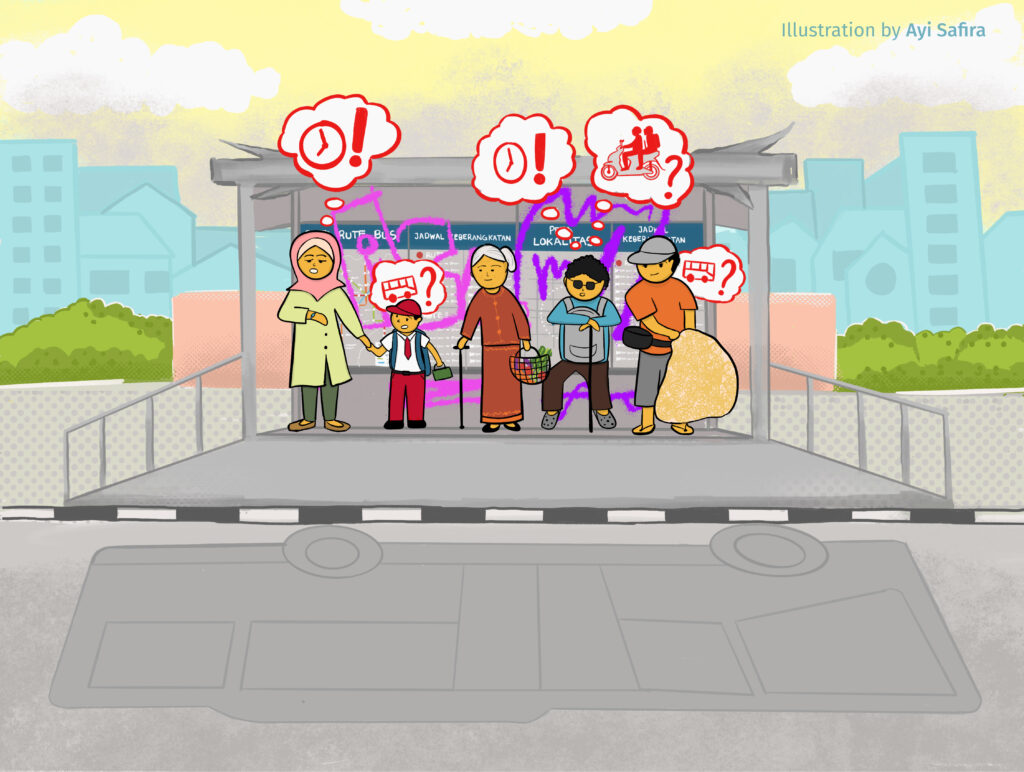
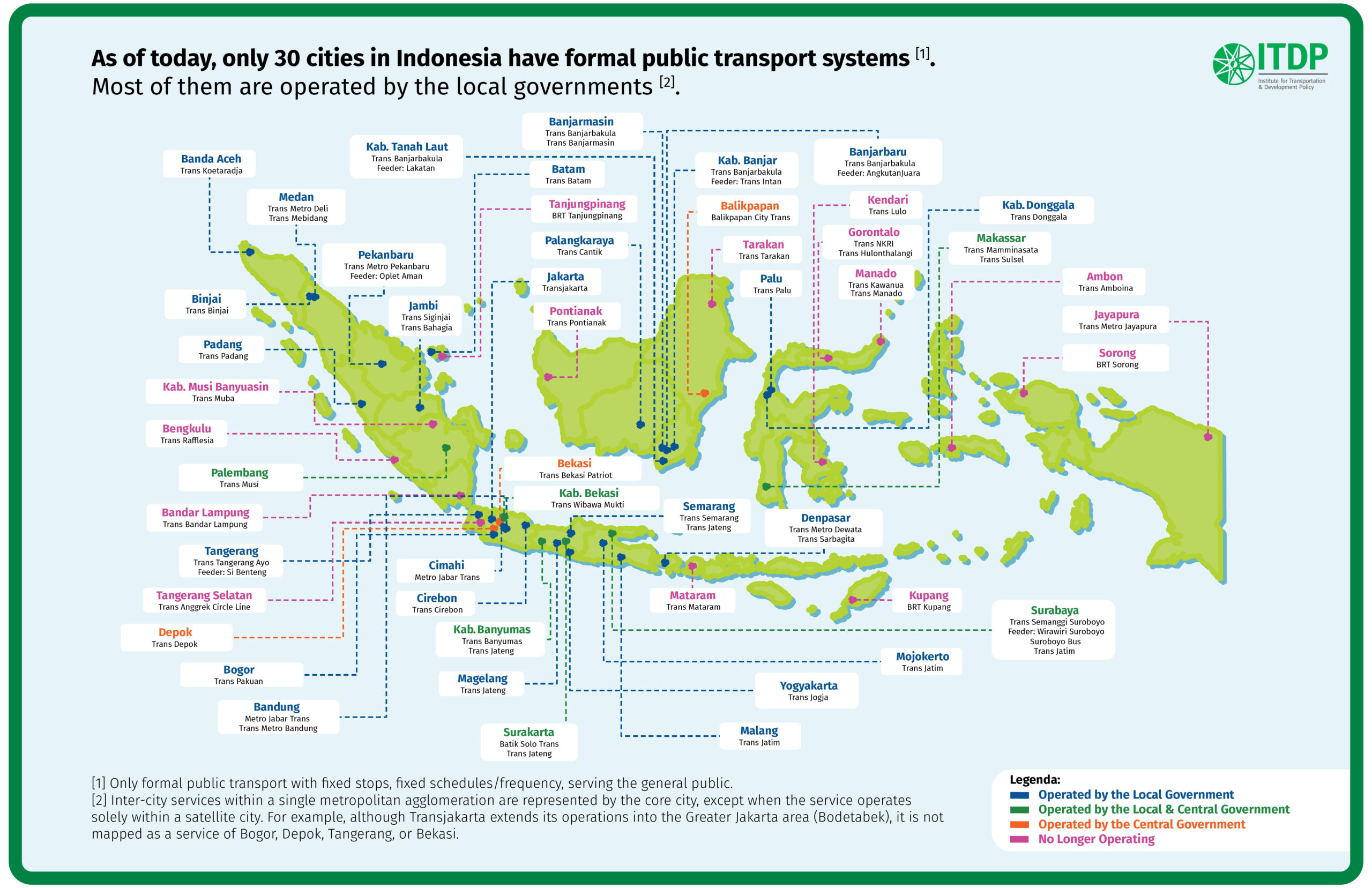
Over the past three years, as we completed various studies and research on electric buses and gender-based violence in public transport across more than six cities in Indonesia, we observed a troubling picture of how public transport is being managed. On the one hand, there has been real progress. In Jakarta, public transport coverage has reached around 90% of the city, supported by the MRT and LRT networks. On the other hand, in many different cities, public transport has instead regressed: the Teman Bus program has been discontinued one by one, corridors and budgets have been cut, and residents have lost access to services that had begun to improve.
Cuts to the Regional Transfer Funds (Transfer ke Daerah/TKD) have further constrained local governments’ fiscal capacity to finance various sectors, including public transport. In the 2026 Draft State Revenue and Expenditure Budget, TKD allocations were sharply reduced—from Rp919.9 trillion in 2025 to Rp650 trillion, a drop of around 29%.¹ Previously, in 2025, the government also reduced TKD by Rp50.59 trillion through Minister of Finance Decree No. 29/2025 as part of national budget efficiency measures.²
At the same time, our legal framework classifies transportation as a non-basic mandatory function under Law No. 23/2014 on Regional Governance. This means local governments are obligated to manage the transport sector, but providing reliable urban public transport is not categorized as a basic service on par with education or health. In other words, the existence of city buses and BRT systems depends more on political will and budget priorities, not on a clearly defined minimum service obligation.
Interestingly, when we mapped public transport systems across different cities, local fiscal capacity did not always determine outcomes.
Many mayors with limited local government budgets chose to make public transport a top priority, while others with far larger fiscal capacity did not. For this reason, the notion that “only Jakarta can have good public transport” is no longer relevant. Just compare Semarang with its Trans Semarang system, or Pekanbaru with Trans Metro Pekanbaru, and Padang with Trans Padang, rather than fiscally larger cities such as Surabaya³.
The Growing Burden of Transport Costs on Households
What is often overlooked is that limited mobility options not only cause congestion and air pollution but also drive up household transport costs. According to the Household Expenditure Survey by Statistics Indonesia (BPS), as cited by the Ministry of Transportation, Indonesian households spend an average of 12.46% of their monthly living costs on transport, whereas the World Bank’s ideal benchmark is no more than 10%⁴.
In several major cities, monthly transport expenses range from Rp1–2 million per household, making it one of the most burdensome components of living costs—especially for low-income and vulnerable groups, particularly women, the elderly, and persons with disabilities who make up the majority of public transport users.
Cuts to public transport, whether in service hours, fleet availability, or accessible infrastructure, leave residents dependent on pricier private motorized options like ride-hailing and non-integrated angkot, which, in turn, increase their daily travel costs.⁵
This reinforces the idea that public transport is not merely a technical issue but a matter of social equity. When the state withdraws from funding, the most affected are women, informal workers, students, low-income households, and other vulnerable groups who depend heavily on public transport.
Cities Are Not Waiting
Despite Jakarta’s fiscal capacity to build a BRT network covering 90% of the city, along with MRT and LRT systems, several cities with far smaller budgets have instead become examples of strong political commitment.
Semarang, for example, enacted Regional Regulation No. 11/2024 on Transport Operations, which requires allocating at least 5% of local government budgets6 to passenger transport subsidies, including public transport. With a local government budget of around Rp5.5 trillion in 2025, allocations for Trans Semarang amount to hundreds of billions of rupiah—a substantial commitment for a city outside Jakarta.⁷
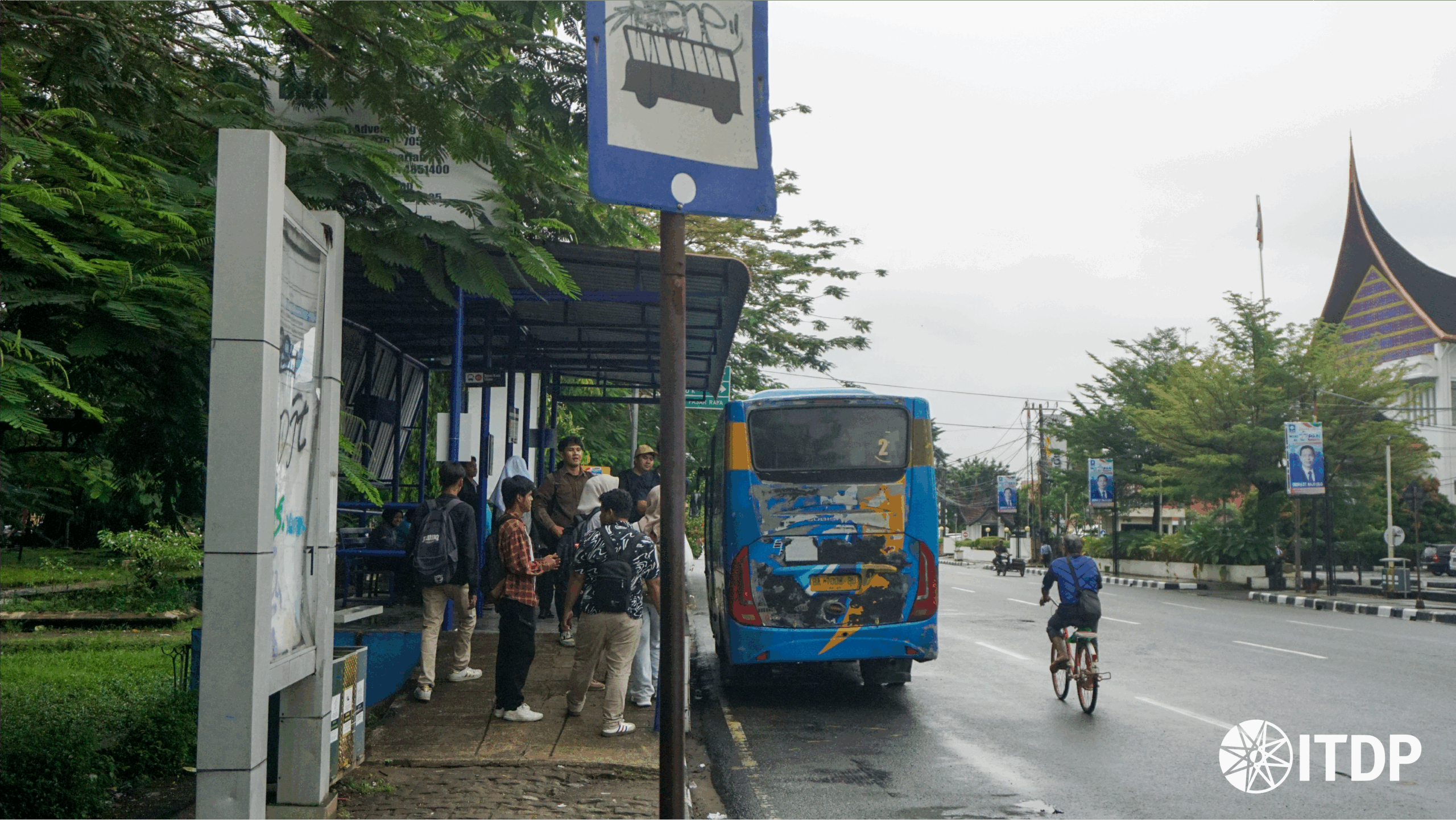
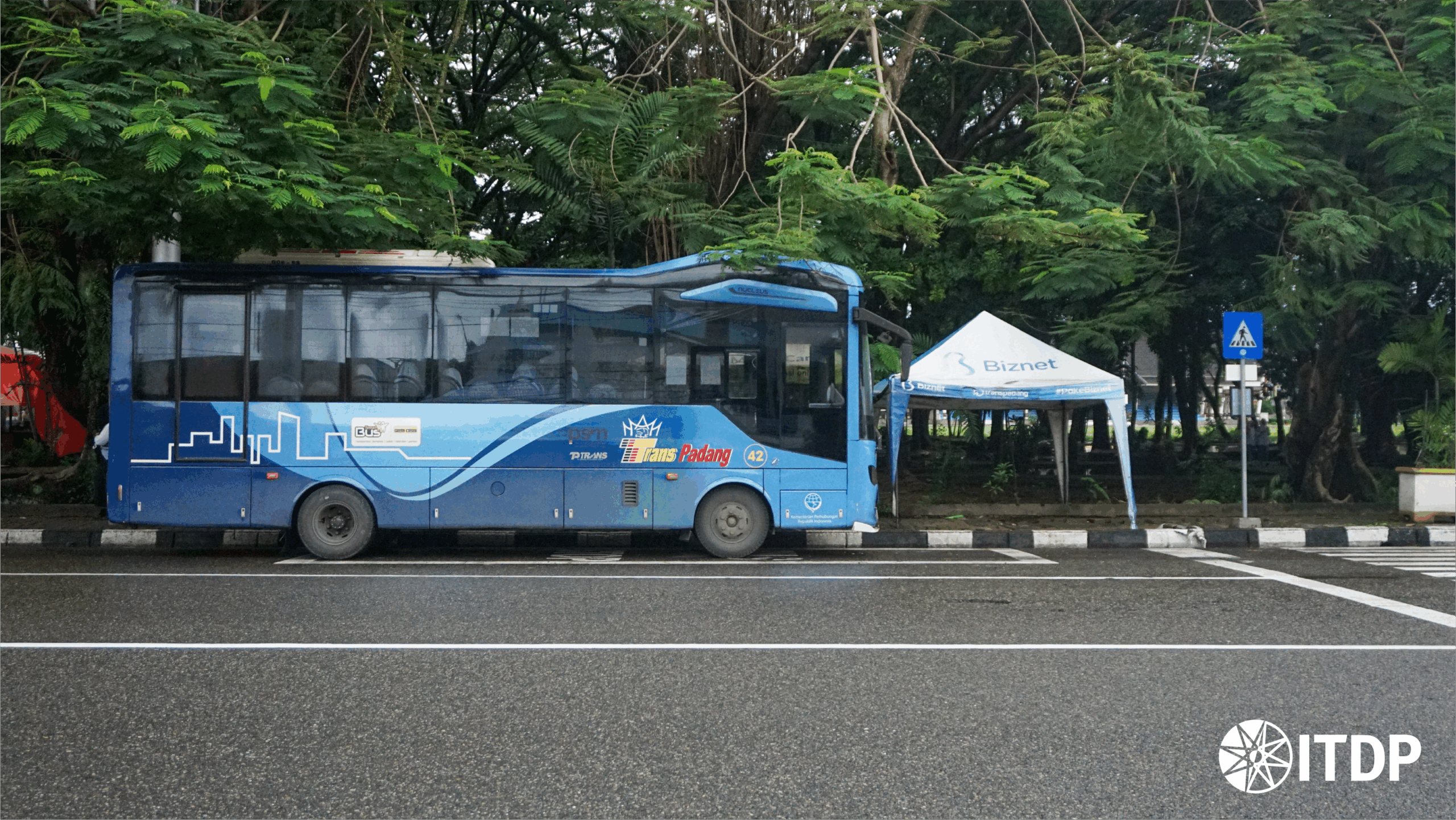
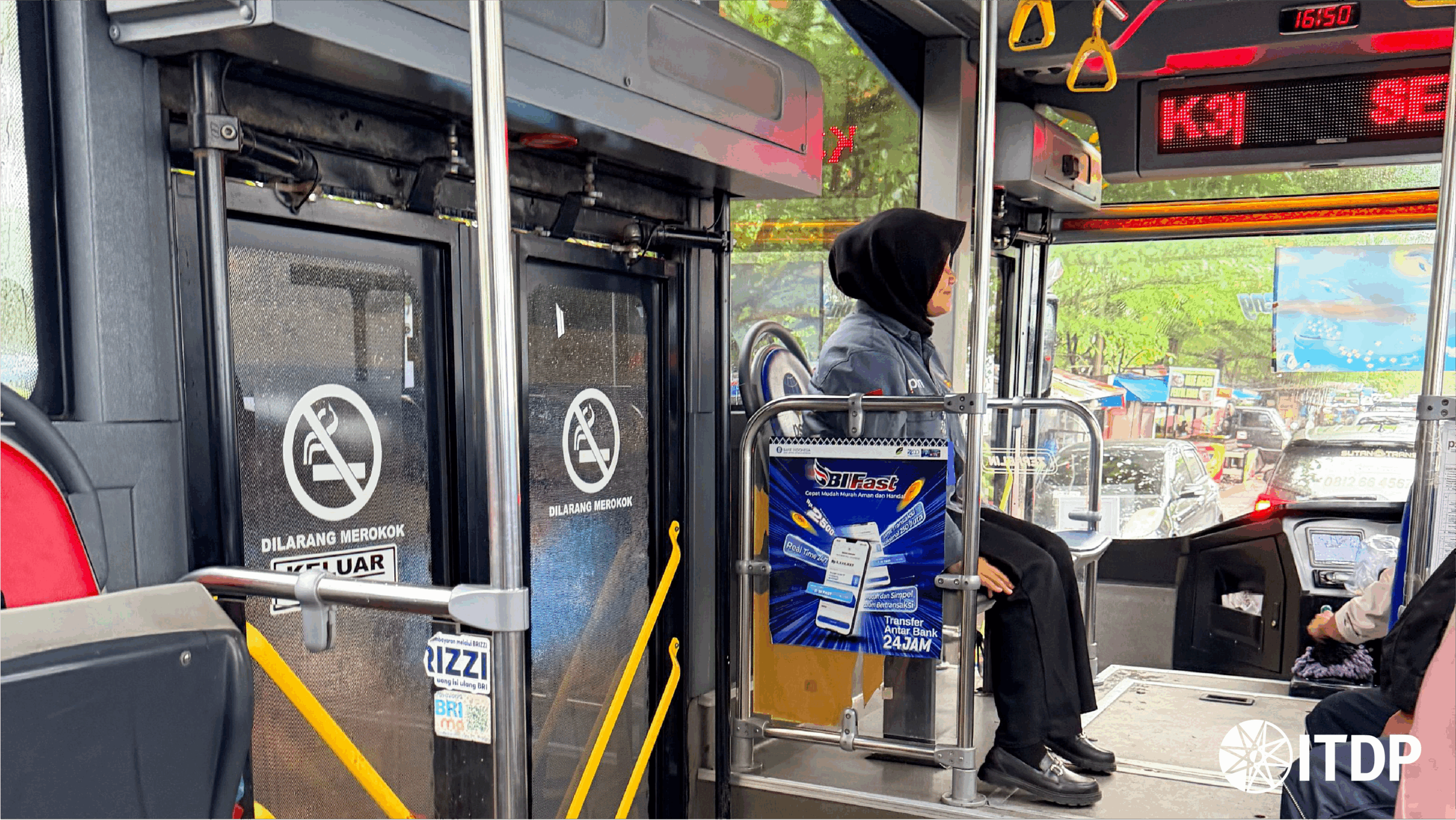
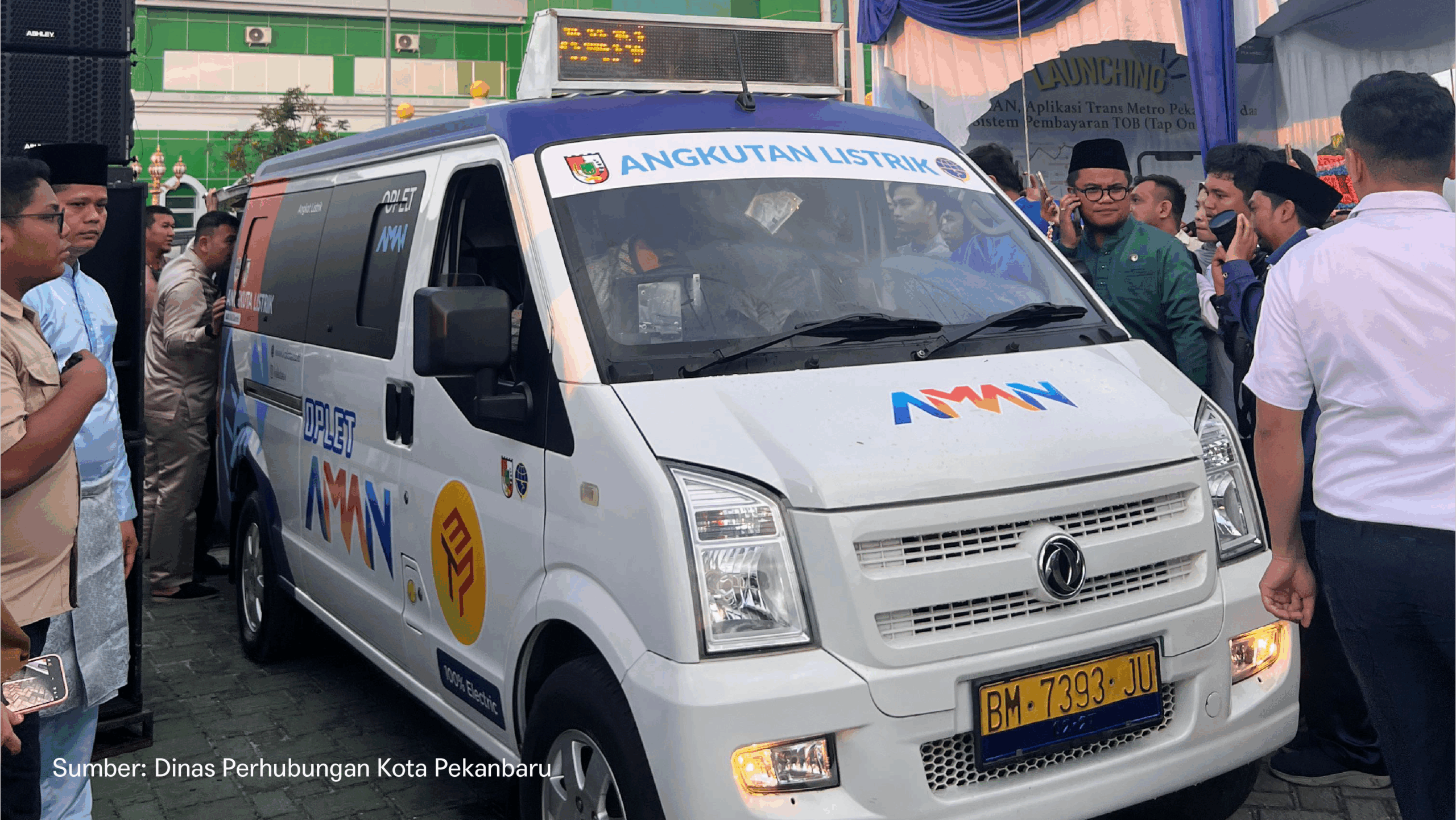
Padang, through Trans Padang, has managed to operate its city bus system consistently for more than a decade—without the Teman Bus program and with relatively limited central government support. At peak hours, most passengers are women and students, the groups who benefit most from reliable and affordable services. Pekanbaru, which also commits up to 5% of its budget for public transport (Regional Regulation No. 2/2024), has begun expanding its city bus network and now operates eight electric angkot units as part of its electrification strategy. This indicates that awareness of the energy transition and sustainable transport has begun to take root at the local level.
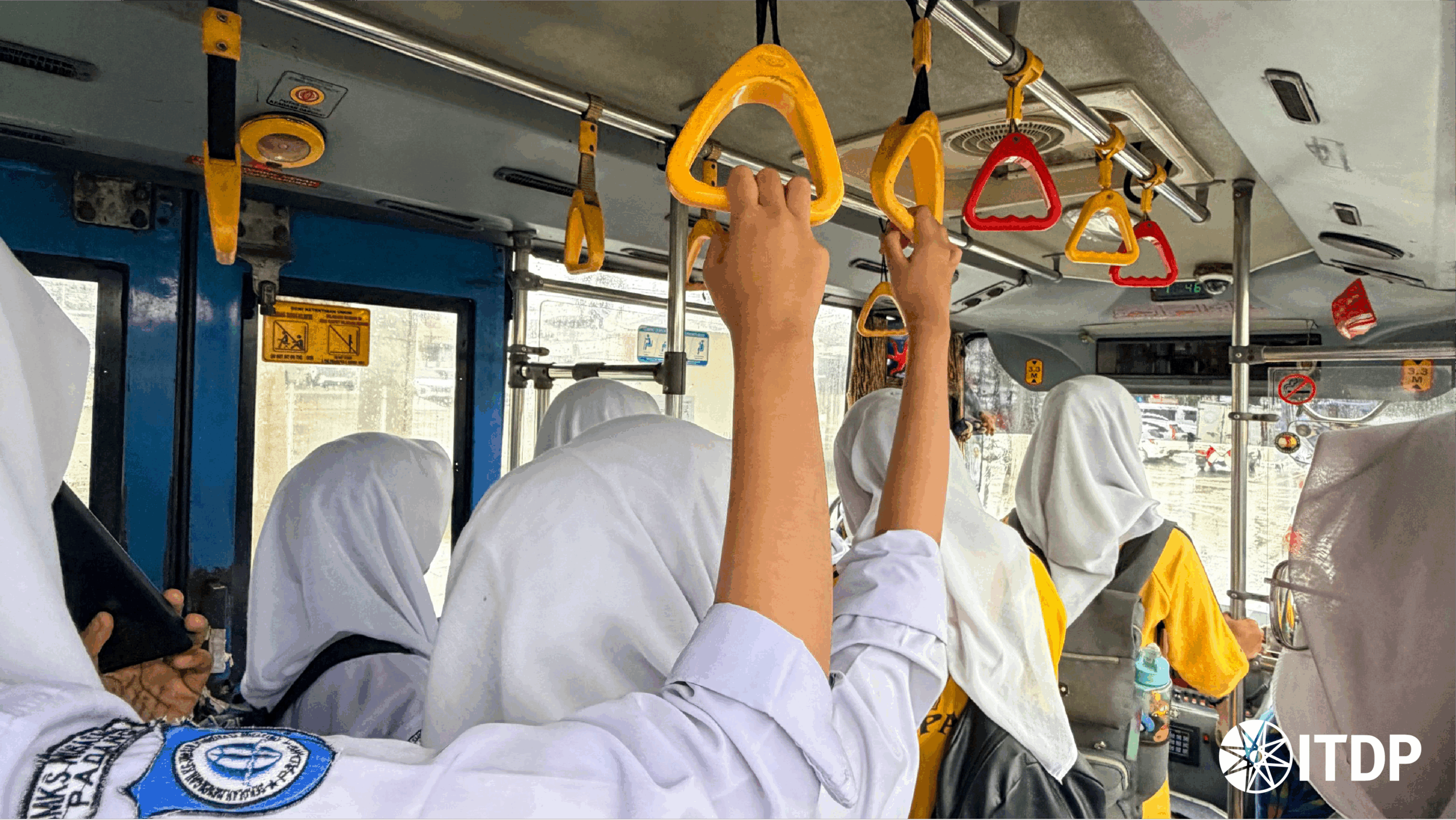
Lessons from Transjakarta show that by 2024, the Operating Cost per Kilometre of its electric buses was already about 5% lower than that of conventional fossil-fuel buses, in line with ITDP’s 2022 projections8. In line with this, operational data from EVs operated by PT Kalista Nusa Armada (KALISTA) in Medan, for example, shows a potential energy cost savings of up to 79%9.
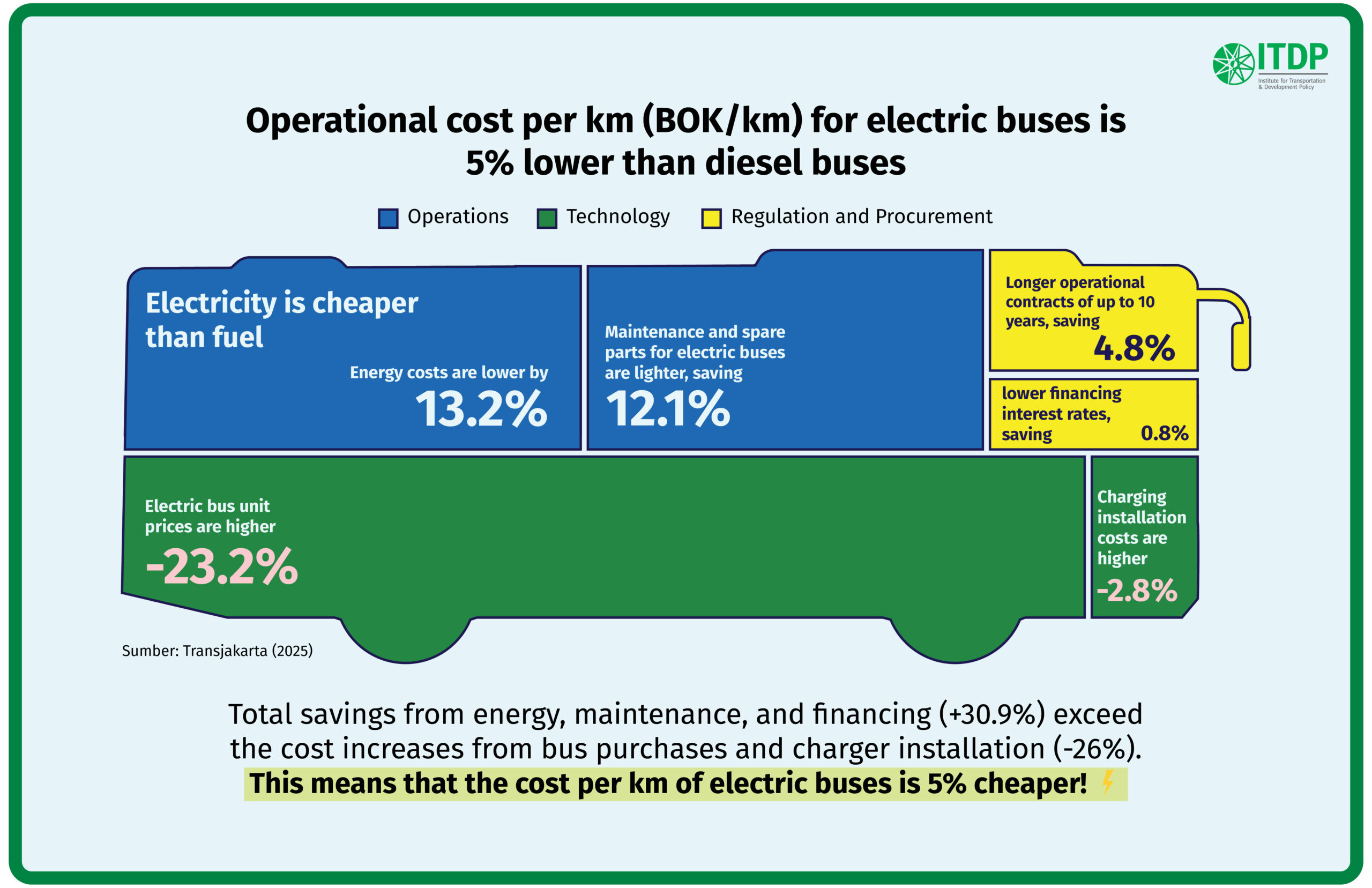
This means that with the same subsidy amount used to operate diesel buses, local governments can now operate the same number of buses—or even more—using electric buses that are more efficient and low-emission.
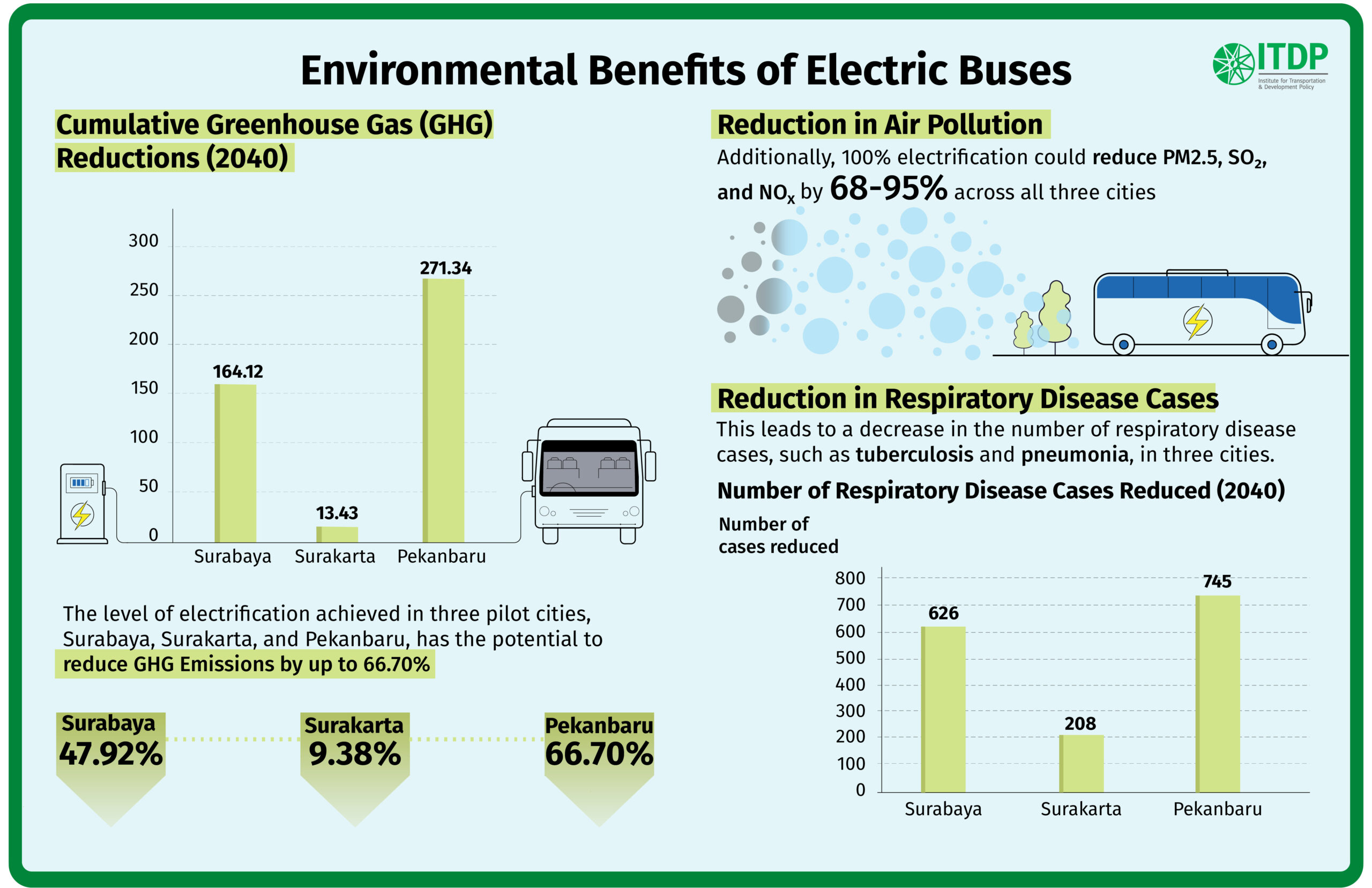
From an environmental perspective, electrifying urban bus fleets has a significant impact. According to ITDP’s study on public transport electrification in Jakarta, city buses account for around 45.7% of transport sector greenhouse gas emissions and 21.4% of local air pollution. With the gradual electrification of Transjakarta, potential greenhouse gas reductions are estimated at around 611,580 tCO₂e by 203010. This reduction translates into lower pollution-related health risks and long-term savings in healthcare costs.
Although several cities—such as Semarang, Padang, and Pekanbaru—have shown independent financing initiatives, the role of the national government remains crucial to ensuring service sustainability. The reduction of the Regional Transfer Funds (TKD) in the 2026 Draft State Revenue and Expenditure Budget and additional cuts planned for 2025 may further constrain regional fiscal space, making central government support increasingly essential for sustaining public transport services11.
Without a more stable national funding scheme—whether in the form of dedicated allocations for public transport, national incentive programs for electric buses, or a sustainable buy-the-service model—cities that are taking bold steps today may be forced to scale back in the years ahead. In other words, cities can be creative and progressive, but the backbone of financing must still be strengthened by the central government.
Public Transport Reform: Learning from Jakarta’s Mistakes
In nearly all major cities in Indonesia, congestion and air pollution are everyday challenges. Public discourse often gets stuck on solutions such as “adding more buses” or “expanding MRT and LRT lines.” Jakarta’s experience shows that this is not enough.
Jakarta already has the most comprehensive public transport network in Indonesia: Transjakarta, the world’s longest BRT system; MRT and LRT networks; commuter rail; cycling lanes; and various intermodal integration initiatives. Yet congestion remains high, and air quality is still far from ideal. One of the main reasons is that Transport Demand Management (TDM) policies lag far behind, and the transition from diesel buses to electric buses has not been aggressive enough.
Electric bus technology has only become increasingly affordable and relevant for Indonesia in the past five years. Given its long-term benefits, Transjakarta—which already operates around five thousand diesel buses with an average daily mileage of 200 kilometers—needed to begin its transition to electric buses starting in 2022. This process has not been easy for Jakarta due to the large scale of its fleet. However, operational costs for electric buses have now reached parity with diesel buses, marking an important turning point for the adoption of this technology. This creates a significant opportunity for other cities, whose bus fleets remain relatively small, to adopt electric buses directly as the backbone of their public transport systems—without having to undergo a long transition process like Jakarta.
Cities worldwide have shown the benefits of electrifying public transport. Shenzhen, China, for example, has converted more than 16,000 buses to electric since 2017, reducing carbon emissions and operational costs. Through an innovative business model, Santiago, Chile, has deployed 2,550 electric buses12, achieving up to 80% PM2.5 reduction, 44% noise reduction13, and a 32% decrease in total cost of ownership (TCO) relative to diesel buses14, and is targeting 4,400 electric buses15 by 2025. Jakarta has a similar opportunity.
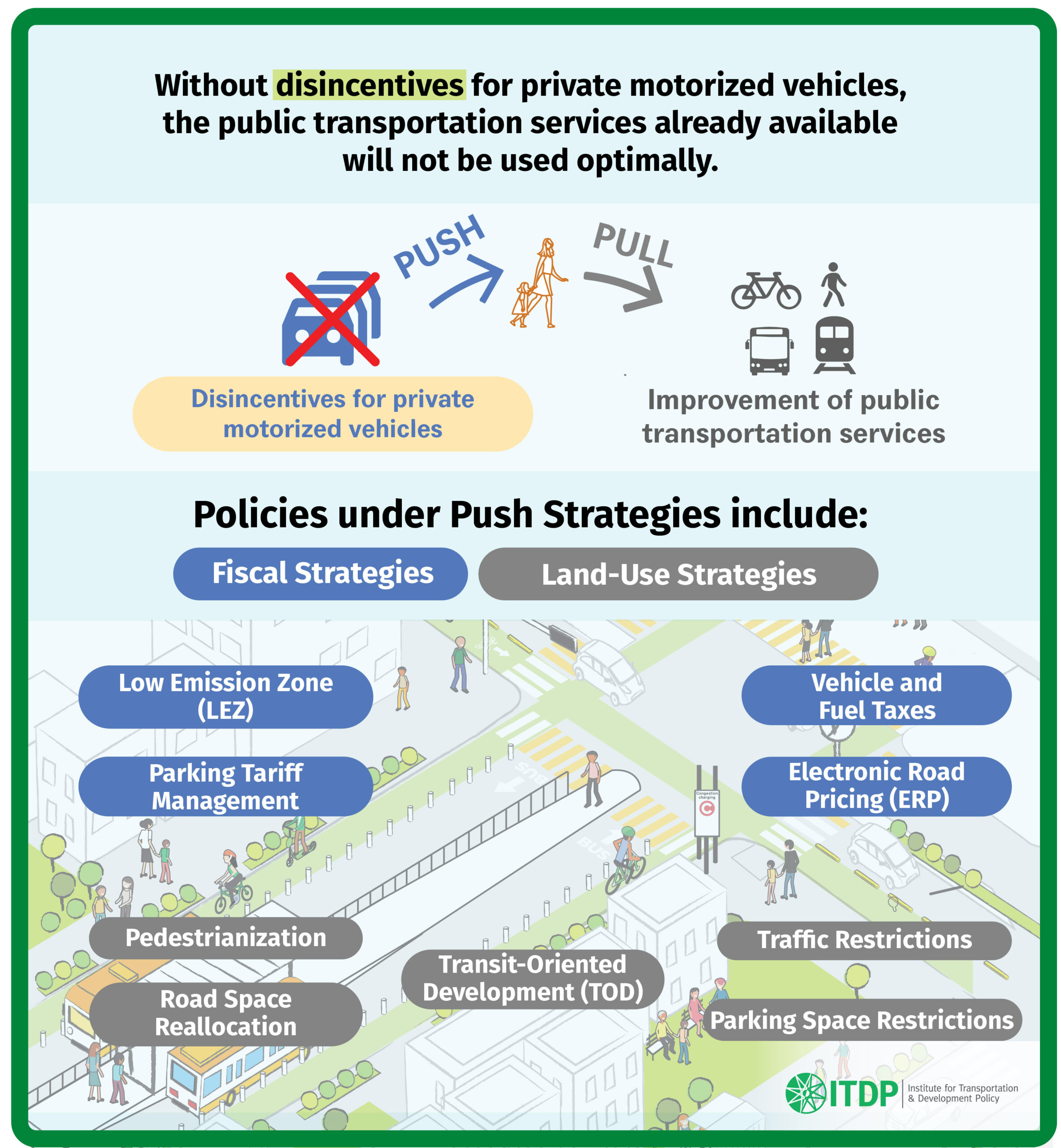
Regarding congestion, restricting the use of private motor vehicles through Transport Demand Management (TDM) is essential. Parking fees in Jakarta’s city centre remain far too low for a metropolitan area. Low Emission Zones (LEZ) remain limited and have not become practical tools for managing vehicle use. At the same time, Electronic Road Pricing (ERP) continues to be delayed despite more than a decade of discussion. The Odd-Even policy still exists but is weakly effective, as it merely shifts travel times and even creates a rebound effect where households purchase additional vehicles with different license plates.
Without strong TDM measures such as ERP and expanded LEZ implementation—policies capable of influencing user behavior with more measurable and lasting impact—cities will remain trapped in a tiring cycle: adding more public transport → congestion persists → people continue choosing private vehicles → emissions and pollution stay high → public transport quality, particularly buses, continues to decline.
In many countries, the quality and affordability of public transport reflect the government’s commitment to its citizens’ welfare. Indonesia has made significant progress, and cities outside Jakarta are beginning to show that they can go even further. However, without consistent national policies, supportive central funding, and political courage to implement TDM, these advancements will always be at risk of stalling.
Ultimately, the central government stands to benefit most from cities with strong, reliable public transport systems. When high-quality and affordable public transport is available, it expands access to jobs, education, and essential services, which in turn reduces poverty, broadens economic opportunities, and drives national economic growth. In other words, supporting cities in building sustainable public transport is fundamentally an investment in strengthening the foundation of Indonesia’s overall economic development.
References:
- Simanjuntak, A. K. M. (2025, August 18). Susut 29%, Alokasi Transfer ke Daerah Pada 2026 Hanya Rp650 Triliun. DDTCNews. https://news.ddtc.co.id/berita/nasional/1813001/susut-29-alokasi-transfer-ke-daerah-pada-2026-hanya-rp650-triliun
- Silfia, I. (2025, February 5). Sri Mulyani Pangkas Dana Transfer ke Daerah Rp50,59 Triliun. Antara News. https://www.antaranews.com/berita/4628573/sri-mulyani-pangkas-dana-transfer-ke-daerah-rp5059-triliun
- Mangontan, E. (2025. February 10). Mengokohkan Komitmen Layanan Transportasi Publik Kota Semarang dengan Koridor Hijau. ITDP Indonesia. https://itdp-indonesia.org/2025/02/mengokohkan-komitmen-layanan-transportasi-publik-kota-semarang-dengan-koridor-hijau/
- Cakti, A. (2025, July 10). Kemenhub Siap Kaji untuk Reduksi Tingginya Biaya Transportasi Warga. Antara News. https://m.antaranews.com/berita/5005521/kemenhub-siap-kaji-untuk-reduksi-tingginya-biaya-transportasi-warga
- Hikam, H. (2025, July 31). Survei Membuktikan! Ongkos Transportasi Kuras Kantong Warga RI. detikFinance. https://finance.detik.com/berita-ekonomi-bisnis/d-8038837/survei-membuktikan-ongkos-transportasi-kuras-kantong-warga-ri
- Mangontan, E. (2025. February 10). Mengokohkan Komitmen Layanan Transportasi Publik Kota Semarang dengan Koridor Hijau. ITDP Indonesia. https://itdp-indonesia.org/2025/02/mengokohkan-komitmen-layanan-transportasi-publik-kota-semarang-dengan-koridor-hijau/
- Rochimawati. (2025, May 18). Pengamat: Trans Semarang Butuh Pembenahan untuk Tingkatkan Layanan Transportasi Publik. Majalah Lintas. https://www.majalahlintas.com/pengamat-trans-semarang-butuh-pembenahan-untuk-tingkatkan-layanan-transportasi-publik/
- Anam, R. (2025, July 3). Bagaimana Kabar Bus Listrik dalam Komitmen Elektrifikasi Nasional? ITDP Indonesia. https://itdp-indonesia.org/2025/07/bagaimana-kabar-bus-listrik-dalam-komitmen-elektrifikasi-nasional/
- Parsaulian, D. (2025, December 6). Kalista Dapat Sediakan Bus Elektrik Sebagai Sarana Transportasi Publik. Media Indonesia. https://mediaindonesia.com/otomotif/837515/kalista-dapat-sediakan-bus-elektrik-sebagai-sarana-transportasi-publik
- Siregar, D. (2023, July 25). Memastikan Inklusivitas dalam Elektrifikasi. ITDP Indonesia. https://itdp-indonesia.org/2023/07/memastikan-inklusivitas-dalam-elektrifikasi/
- Silfia, I. (2025, February 5). Sri Mulyani Pangkas Dana Transfer ke Daerah Rp50,59 Triliun. Antara News. https://www.antaranews.com/berita/4628573/sri-mulyani-pangkas-dana-transfer-ke-daerah-rp5059-triliun
- Red Movilidad. (2025, April 23). Red buses generate only 3.3% of transport emissions in Santiago: 90% come from private cars and Motorcycles. https://www.red.cl/en/red-communicates/buses-red-generan-solo-el-33-de-las-emisiones-del-transporte-en-santiago-el-90-viene-de-autos-y-motos-particulares/
- InvestChile Blog. (2025, May 5). Electric buses in Santiago account for just 3% of total emissions. https://blog.investchile.gob.cl/electric-buses-emissions/
- Sustainable Bus Blog. (2025, April 22). Santiago de Chile aims to introduce 1,800 e-buses this year (thus achieving 68% zero emission bus fleet). https://www.sustainable-bus.com/news/santiago-chile-1800-electric-buses-2025/
- Sustainable Bus Blog. (2022, November 9). New study in Santiago, Chile shows that electric buses have lower TCO than diesel. https://www.sustainable-bus.com/news/santiago-electric-buses-tco-diesel/