
May 25, 2026
ITDP Indonesia Advocates for More Comprehensive Urban Mobility Policies at Busworld Southeast Asia 2026
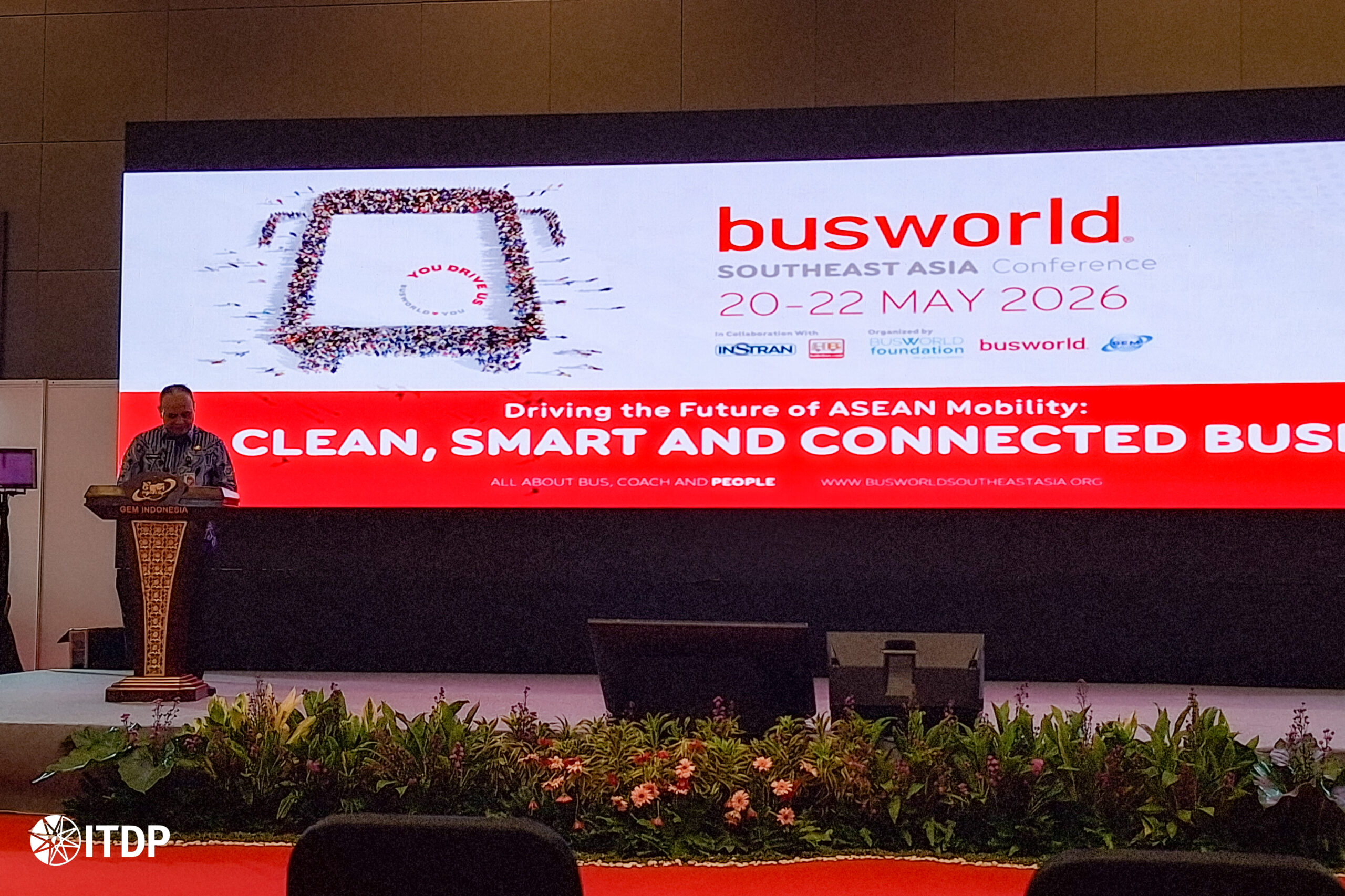
changes—becoming more modern, better integrated, and increasingly environmentally friendly. This evolution has been especially significant in Southeast Asia, particularly in Indonesia, which plays a key role in the bus industry with its strong manufacturing base and coachbuilding ecosystem that closely collaborates with international chassis manufacturers.
Against this backdrop, Busworld Southeast Asia returned to Indonesia for its biennial event. Held at Jakarta International Expo (JIExpo) Kemayoran from 20–22 May 2026, Busworld Indonesia once again invited ITDP to participate as a media partner, moderator, and speaker in conference sessions held on 20 and 22 May.
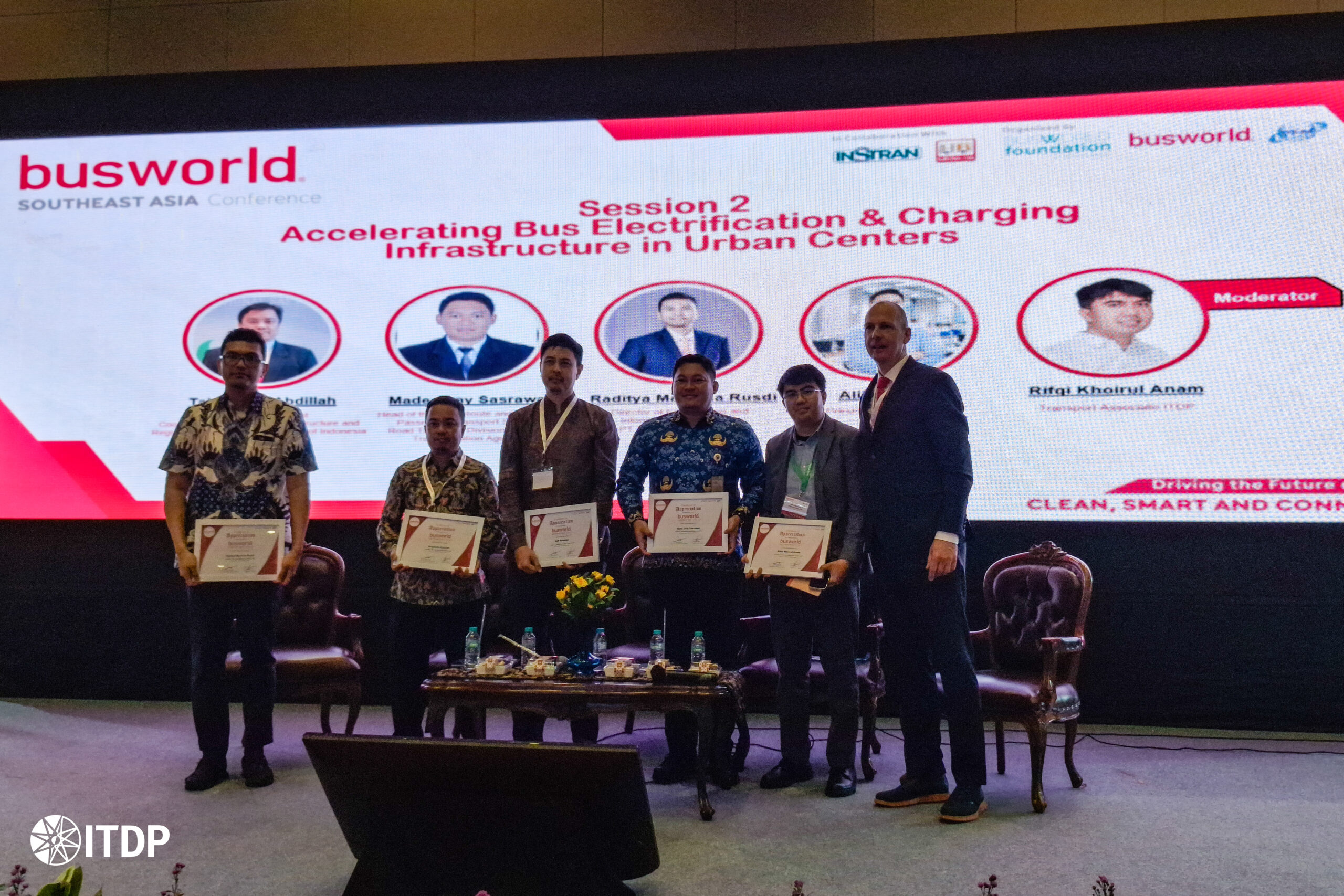
On 20 May, ITDP Indonesia Transport Associate Rifqi Khoirul Anam moderated the session “Accelerating Bus Electrification and Charging Infrastructure in Urban Centers.” The panel featured Tahyanto Abdillah, Senior Policy Analyst at the Coordinating Ministry for Infrastructure and Regional Development; Made Jony Sasrawan, Head of Route-Based Passenger Transport and Terminal Division; Raditya Maulana Rusdie, Director of Engineering and Information Technology at Transjakarta; and Alif Sasetyo, President Director of INVI.
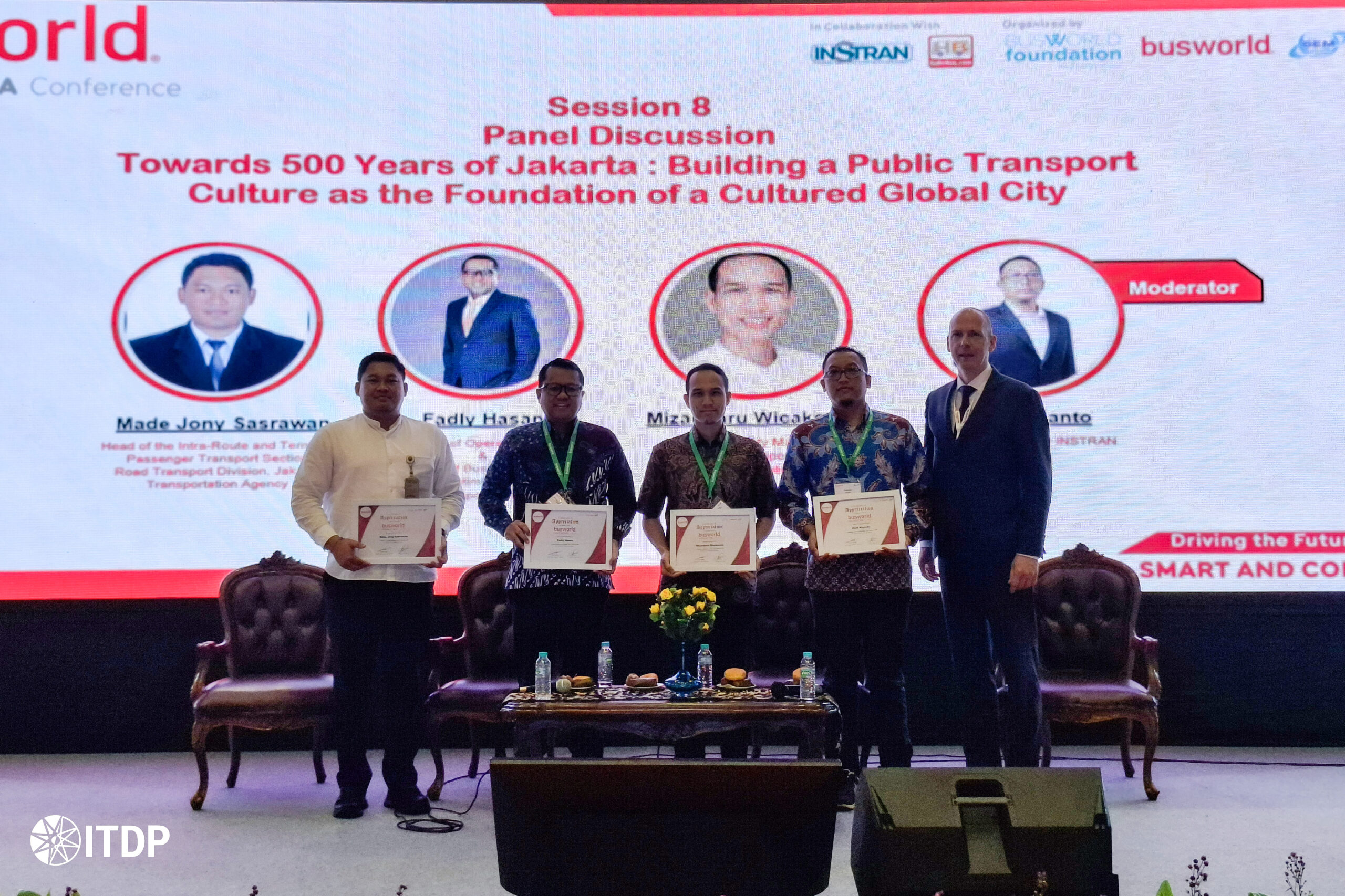
The session opened with an overview of public transport in Jakarta delivered by Made Jony Sasrawan, followed by Fadly Hasan. Today, Transjakarta ranks 17th among the world’s best public transport systems and second in Southeast Asia. It now serves 92.5% of Jakarta’s population within a maximum radius of 500 meters and carries approximately 1.4 million passengers daily.
Despite this progress, Transjakarta’s modal share currently stands at only 22%, far below the government’s target of 60% by 2029. The challenge, however, does not lie in fleet size—Transjakarta itself operates around 200,000 vehicles—but rather in infrastructure constraints, including an insufficient number of bus stops and overcrowded stations.
Two major solutions have been proposed: improving connections between bus stops and Jakarta’s LRT, MRT, and commuter rail (KRL) systems to distribute passenger demand more evenly, and revitalizing 46 of the city’s 250 bus stops. To further strengthen connectivity between Transjakarta and MRT, LRT, and KRL stations, the Jakarta provincial government has also revitalized Tanah Abang, Senen, Juanda, Sudirman, Palmerah, Tebet, Manggarai, Gondangdia, and Jakarta Kota commuter rail stations to better support Jakarta’s 10 major mobility hubs and surrounding satellite cities.
In addition to expanding wheel-based public transport services (Transjakarta) and rail-based systems (KRL, LRT Jakarta, and MRT Jakarta), the Jakarta provincial government is also targeting these areas for TOD development. To date, three TOD locations have been established: Dukuh Atas—integrated with Transjakarta, MRT, LRT Jakarta, LRT Jabodebek, KCI commuter rail, and the airport rail link—as well as Blok M and Lebak Bulus, both integrated with Transjakarta and MRT services. Jakarta is also aiming to make Transjakarta more environmentally sustainable, with 700–800 electric buses expected to be operational by 2026–2027.
Other pressing issues raised during the discussion included driver quality, road sterilization (dedicated lane enforcement), pickpocketing, and sexual harassment occurring inside buses and at bus stops. AI- and IoT-based monitoring systems, along with the TJ Academy for driver training, are expected to play an important role in improving service quality and passenger safety.
The discussion continued with a presentation by Mizandaru Wicaksono, Urban Mobility Manager at ITDP Indonesia, on policy options that Jakarta could implement to ease congestion and reduce pollution. The proposed solutions include stronger pull policies, such as updating the odd-even traffic restriction scheme across 25 road corridors, establishing low-emission zones, implementing electronic road pricing, and increasing parking fees to encourage a shift toward public transport.
In implementing odd-even traffic restrictions, Jakarta could draw lessons from Bogotá, Colombia. Bogotá regularly updates and expands the roads covered by its vehicle restriction policy every few years. Combined with pedestrianization efforts, dedicated cycling infrastructure, and strong public transport support, these measures have successfully reduced both congestion and air pollution in the city.
Busworld Southeast Asia 2026 is the largest international bus exhibition in Southeast Asia, held from 20–22 May 2026 at JIExpo Kemayoran, Central Jakarta. In its fourth edition, Busworld Southeast Asia partnered with ASEAN INAPA to showcase the latest developments in automotive industries, commercial vehicles, public transportation, buses, logistics, and spare parts.