October 12, 2026
From Electrification to Inclusive Mobility: ITDP Indonesia Supports Sustainable Transport Financing in Southeast Asia
The transition to sustainable transport requires more than replacing conventional vehicles with electric ones. Intermodal integration, sustainable financing, and inclusive and affordable access to transport are also essential to building a mobility system that puts people first.
These issues were explored in two discussion sessions with Climate Mobility Collective (CMC) South and Southeast Asia partners during Bangkok Climate Action Week 2026 on Wednesday, 7 October, in Bangkok, Thailand.
Transport Integration Is Key to Sustainable Mobility
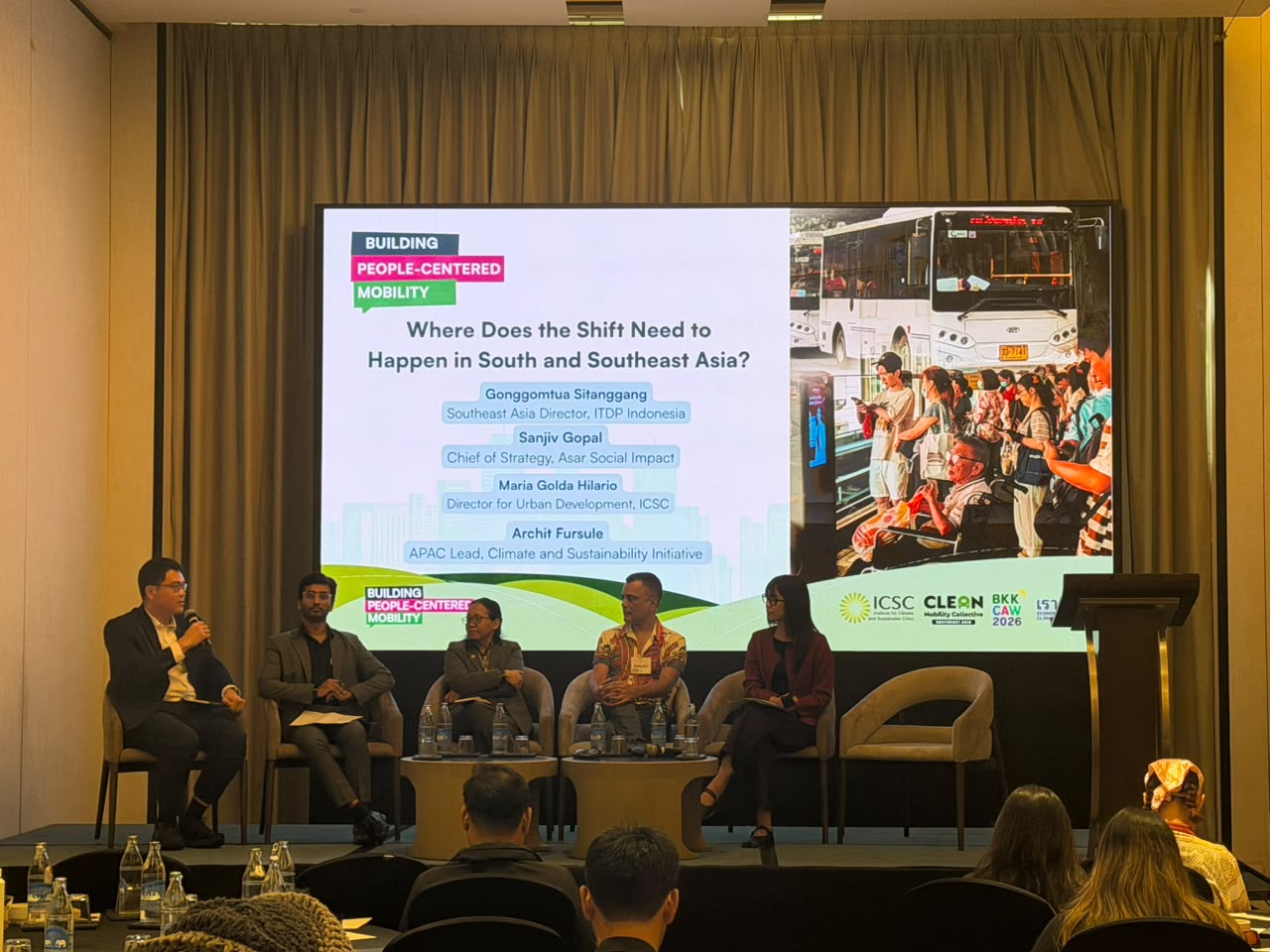
During the session Building People-Centered Mobility: Where Does the Shift Need to Happen in South and Southeast Asia?, ITDP Southeast Asia Director Gonggomtua Sitanggang discussed Jakarta’s public transport transformation and the challenges it continues to face.
Despite significant progress, transport integration remains a challenge, particularly in providing first- and last-mile connectivity. Integration must therefore address physical infrastructure, fare systems, and institutional coordination. ITDP Indonesia also continues to work with governments across Greater Jakarta to promote a transport system that accommodates people’s cross-regional mobility patterns.
Beyond integration, affordability is another key factor in encouraging people to shift to public transport. Improving access to affordable services can create greater opportunities for people to participate in economic activities. Communication and advocacy strategies must also be tailored to the needs of different target groups, including young people.
Electrification Requires the Right Financing Mechanisms
Financing challenges were again a key focus of the session Mobilizing Climate Finance for Sustainable Mobility: Electric Bus Implementation in ASEAN, Financing Mechanisms, and Social Impact.
Drawing on experiences from Thailand and Indonesia, participants highlighted the role of government commitment in driving investment in low-emission transport. Thailand, for example, has introduced its 30@30 policy, which aims for electric vehicles to account for 30% of total vehicle production by 2030. These efforts are also supported by private-sector participation and the exploration of carbon emission reductions as a potential financing mechanism.
Meanwhile, Jakarta has set a target to fully electrify the Transjakarta fleet by 2030, equivalent to approximately 10,000 buses. One identified benefit is that electric buses have operating costs around 5% lower than those of conventional buses. Their quieter operation also improves passenger comfort.
However, the upfront investment required for electric buses remains approximately two to three times higher than that for conventional buses. This cost disparity is one of the main barriers to scaling up electrification. Gonggomtua therefore emphasized the need to explore alternative business models and financing mechanisms to address this challenge. A combination of concessional financing and fleet leasing schemes could help improve budget allocation efficiency.
At the regional level, bulk vehicle procurement, engagement with financial institutions to support public transport infrastructure development, and strengthening city governments’ capacity to plan and implement bus rapid transit (BRT) systems could also help expand sustainable transport services.
An Inclusive Transition Must Go Beyond Replacing Technology
Gonggomtua emphasized that the transition to electric vehicles should serve as an opportunity to improve public transport accessibility, including for persons with disabilities. Features such as Braille signage and designated spaces for wheelchair users can be incorporated into newly procured electric buses.
In terms of employment, electrification also has the potential to create job opportunities across various fields. In this regard, ITDP Indonesia supports the implementation of Transjakarta Academy, including specialized training programmes for women bus drivers. This initiative complements the transition to electric buses by encouraging greater female participation in the public transport sector.
Ultimately, the transition to sustainable mobility is not just about vehicle technology. It is also about who can access transport services, who benefits from them, and how these changes affect workers in the transport sector.
Electrification Must Go Hand in Hand with Avoid–Shift–Improve
Beyond financing and inclusion, the discussions reaffirmed that electrification alone cannot address all transport challenges. Electric vehicles can reduce tailpipe emissions, but they do not inherently solve traffic congestion. Their overall climate impact also depends on the electricity source used to charge them.
Gonggomtua therefore emphasized the importance of the Avoid–Shift–Improve approach: reducing unnecessary travel demand (Avoid), encouraging shifts to more sustainable modes such as public transport and active mobility (Shift), and improving vehicle efficiency while reducing emissions (Improve).
This approach must go hand in hand with the development of more compact cities and transport electrification. A shift towards cleaner energy sources is also necessary to ensure that the benefits of electrification extend beyond reducing emissions at the vehicle level.
The discussions underscored that the future of sustainable mobility in South and Southeast Asia depends on the alignment of policies, financing, and service quality. Electrification must be accompanied by intermodal integration, accessibility, affordability, and people-centered planning to ensure that the transport transition is not only lower in emissions but also more equitable and inclusive.