October 01, 2026
Get on the (Electric) Angkot!
Oleh Budi Utomo, Project Lead ITDP Indonesia 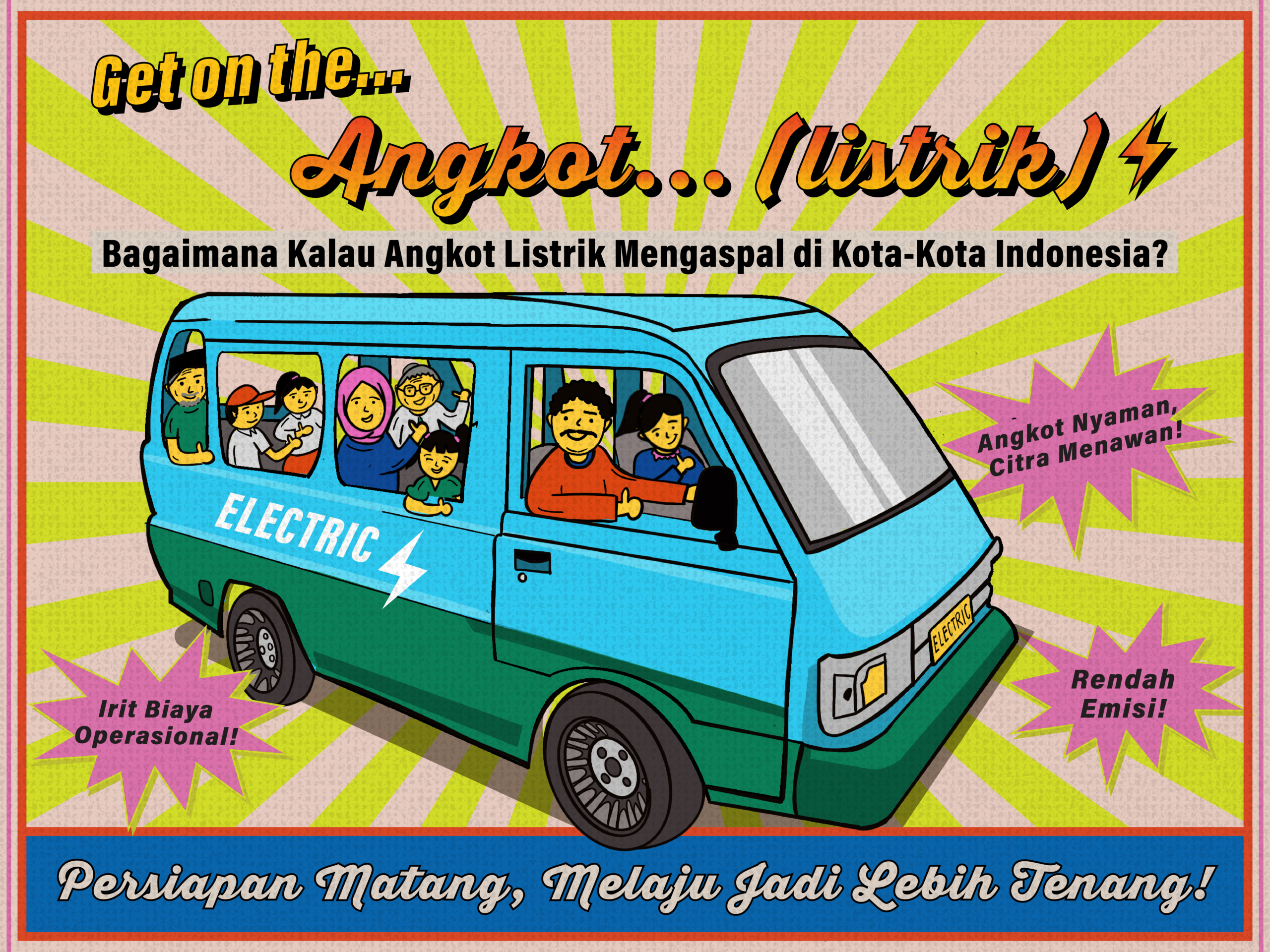
Illustration by Ayi Safira, Urban and Visual Design Associate at ITDP Indonesia
The government’s ongoing efforts to accelerate public transport electrification present a significant opportunity to reform angkot services—making them more modern, inclusive, and sustainable.
No Na’s single Honk! not only caught the attention of Indonesian music fans, but also those familiar with the sound of horns and the roar of engines from angkutan kota (angkot), the minivans that crisscross cities across the country. In several scenes from the music video, the members of No Na pose and dance alongside a shocking-pink Suzuki Carry Futura 1.0 angkot from the mid-1990s.
No Na is presented in a glamorous, modern aesthetic, while the angkot remains a vintage vehicle – an image that may not be far removed from how many people perceive it. As Indonesia’s public transport landscape gradually modernizes, angkot are struggling to keep up. So, how can we ensure that angkot are not left behind on the journey toward public transport electrification?
Angkot in Decline
Today, 85% of Indonesia’s public transport fleet consists of semi-regulated services, or services managed by operators, including angkot1. However, angkot face pressure from multiple directions, from increasing private vehicle use to the emergence of app-based transport services and newer, more modern forms of public transport. In Makassar, angkot, locally known as pete-pete, have seen a significant decline. In 2005, the Makassar City Transportation Agency recorded 4,113 pete-pete operating on the city’s streets. By 2015, the number had fallen to 2,912, then to 1,784 in 2017, 1,227 in 2018, and just 643 in 20252.
A similar trend can be seen in Bogor. While the population continues to grow, the number of angkot continues to shrink.
In the case of Bogor’s angkot, the issue lies in the large number of vehicles that have exceeded the age limit stipulated in Minister of Transportation Regulation (Permenhub) No. 44 of 20193.
As of September 2026, 1,025 angkot had been subject to enforcement measures—meaning that nearly 50 percent of Bogor’s angkot were 20 years old or older. The enforcement is part of the Bogor City Government’s policy to reorganize public transport in accordance with Bogor City Regional Regulation (Perda) No. 8 of 20234.
Electrification as a Strategy for Modernization and Emissions Reduction
ITDP studies show that vehicle electrification alone is not enough to achieve sustainable transport. Avoid, Shift, and Improve strategies need to be pursued in tandem: reducing unnecessary travel through urban planning, encouraging a shift toward public transport and sustainable modes, and improving vehicle technology efficiency through electrification.
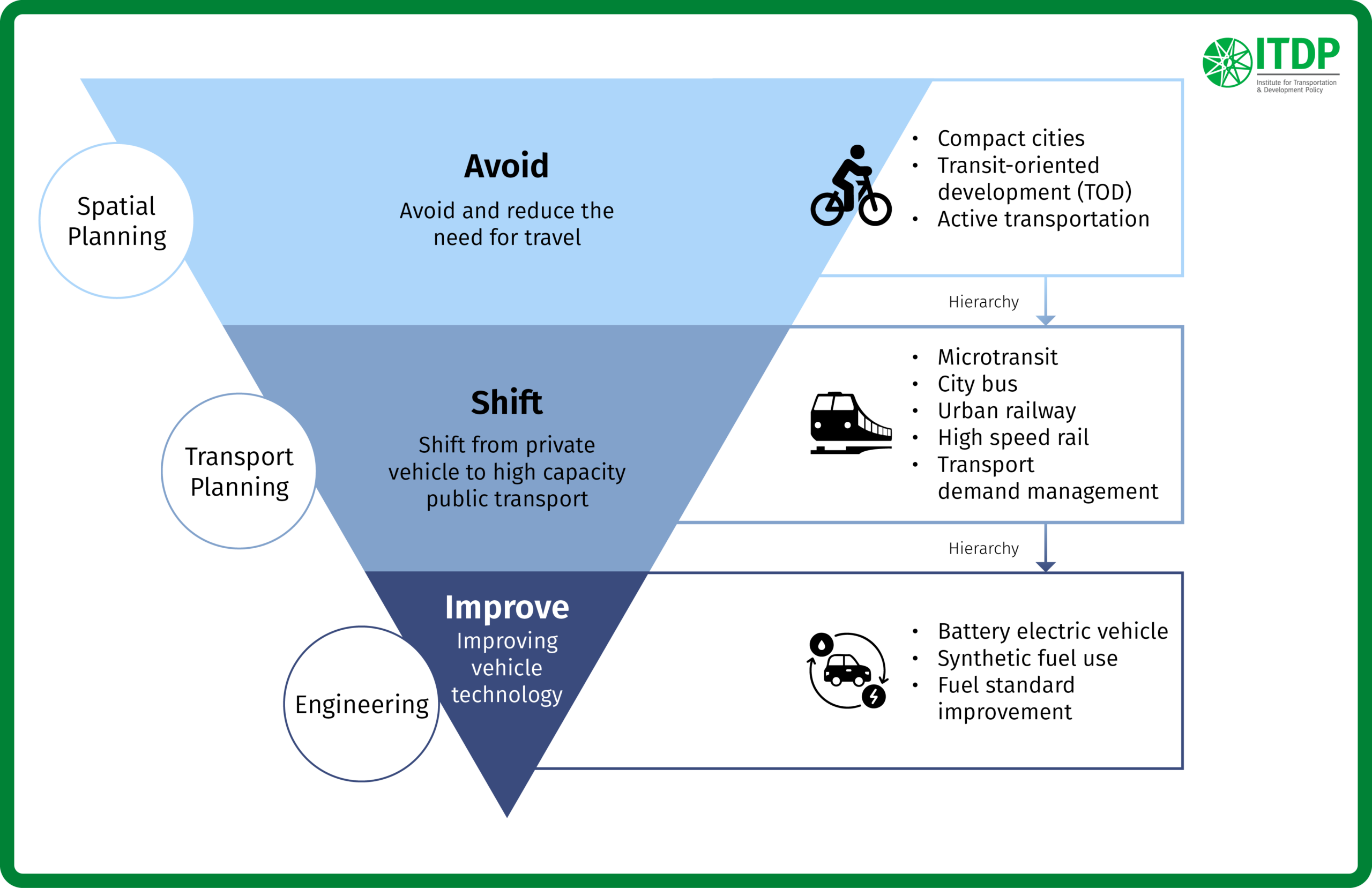
Applying all three strategies is necessary to reduce emissions from the transport sector and support global efforts to limit the rise in the Earth’s average temperature to 1.5°C. A 2024 study by ITDP Global⁵ shows that the Avoid strategy through compact cities and Improve through private vehicle electrification alone are insufficient to achieve this target. These strategies need to go hand in hand with strengthening public transport services to encourage people to Shift to public transport, while also improving vehicle technology through electrification (Improve).
In Indonesia, the transport sector accounts for 25 percent of total national greenhouse gas (GHG) emissions. This high level of emissions is driven by high ownership of fossil-fuel-powered private vehicles and low public transport use, with public transport mode share ranging from only 2–15% in major cities⁶.
An ITDP report (2025)⁷ reveals that electrifying 100 percent of public transport fleets across 11 priority cities by 2030 could potentially reduce GHG emissions by around 25 percent compared with the business-as-usual (BAU) scenario, equivalent to approximately 900,000 tonnes of CO₂eq.
To achieve this target, ITDP Indonesia recommends electrifying feeder services, including angkot⁸. The transition to electric angkot has several prerequisites already in place, such as established operators, routes, and operating patterns. Their smaller vehicle size and wider distribution also make the transition to electric angkot easier than building electric bus infrastructure from scratch.
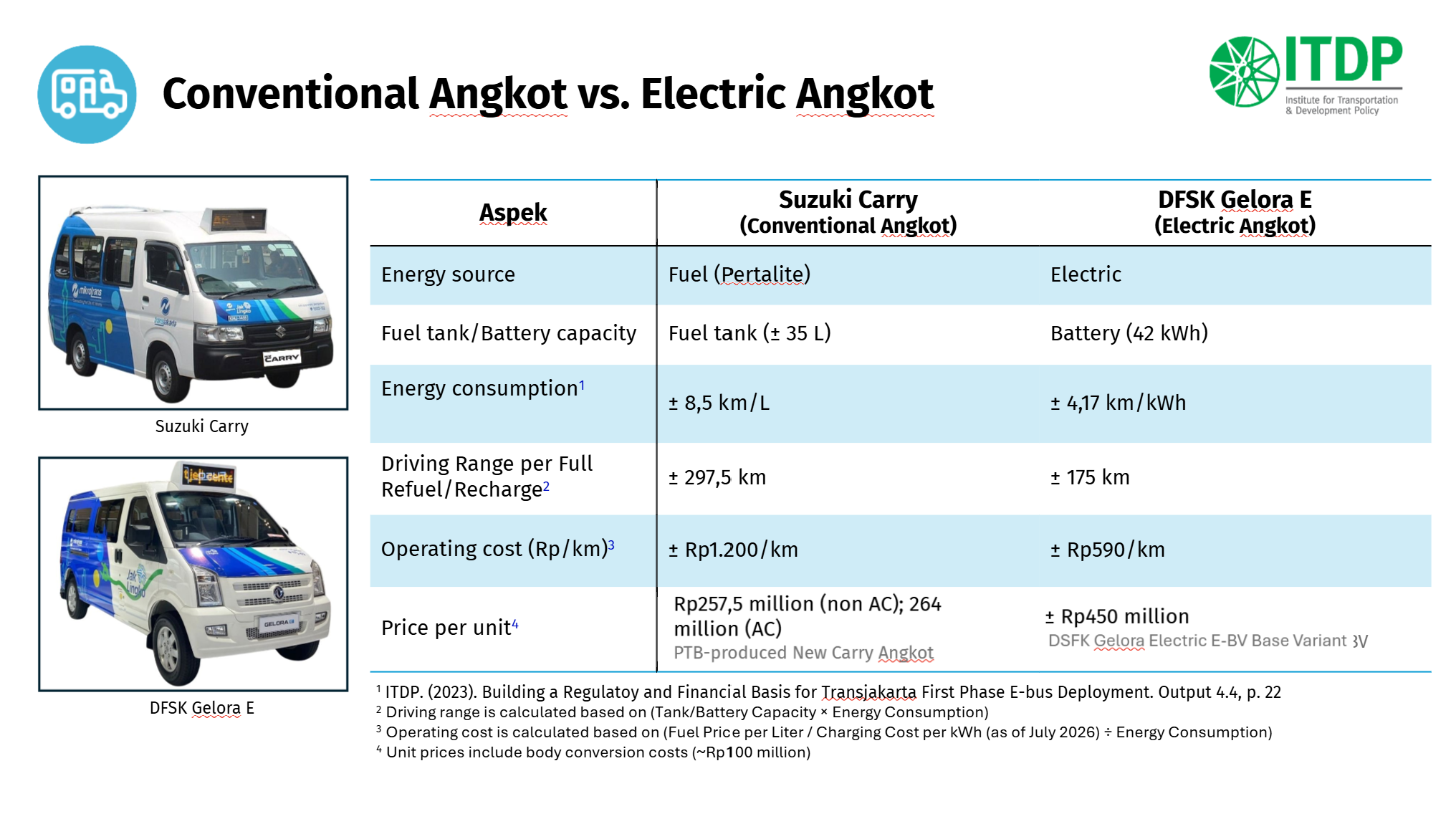
Beyond reducing emissions, electric angkot can lower operating costs while also helping to modernize aging fleets.
An ITDP study shows that the operating cost (BOK) per kilometer of electric public passenger vehicles (MPU—including angkot) is 28 percent lower⁹ than that of conventional small buses.
Over the long term, these lower operating costs could help offset the upfront investment required for electric angkot, which cost nearly twice as much as conventional angkot.
Transition as an Opportunity for Reform
The enforcement of regulations on aging angkot, such as the recent measures taken in Bogor City, could provide an opportunity to reform angkot services by transitioning to electric fleets. This reform would not only help renew aging vehicles, but also improve service quality and reduce urban transport emissions.
The transition to electric angkot is not impossible. In recent years, efforts to transition from conventional to electric angkot have been underway. In Bogor, for example, the city government conducted a trial of electric angkot known as Alibo (Angkot Listrik Bogor). The trial, held from April to July 2024, involved five electric angkot serving 30 route stops¹⁰.
In Pekanbaru, the city government, through its Transportation Agency, launched a trial of four electric angkot called Oplet AMAN in December 2024¹¹. Six months later, in June 2025, eight Oplet AMAN units officially began operating as feeders for the Trans Metro Pekanbaru (TMP) bus system¹². That same year, the Jambi City Government launched three electric angkot under the TRANS Bahagia program¹³. Its launch marked the first buy-the-service (BTS) angkot program in Indonesia. Meanwhile, Jakarta¹⁴ and Bandung¹⁵ have recently begun testing electric angkot as well.
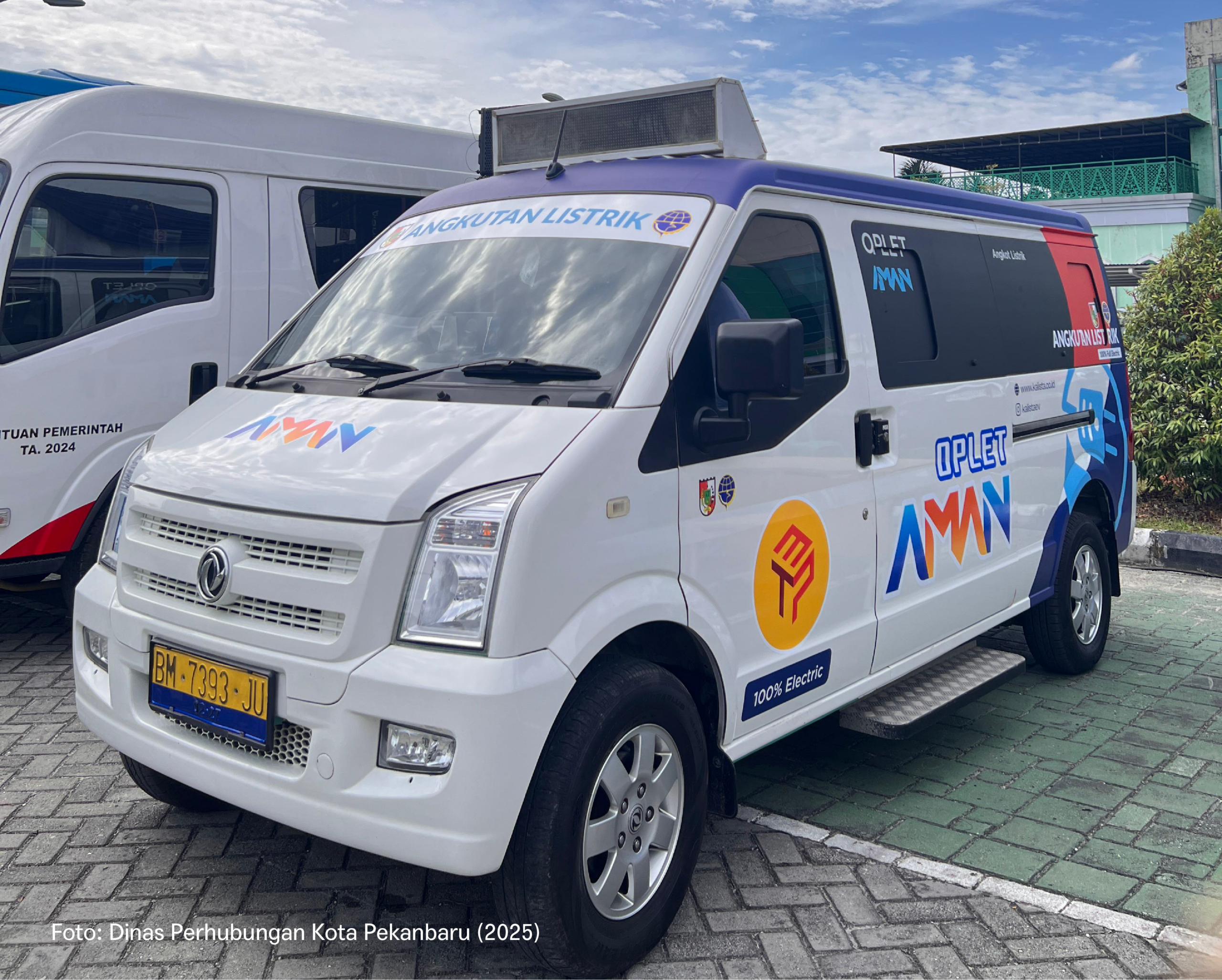
These early experiences show that angkot electrification is possible, provided that it is carefully planned and prepared. Governments, operators, financial institutions, and charging infrastructure providers all need to work together to ensure that the transition—from comprehensive planning through implementation and evaluation—can proceed effectively. Comprehensive planning includes understanding people’s mobility needs (demand), developing operational plans, establishing financing schemes, and ensuring the readiness of supporting infrastructure¹⁶.
Electrification, therefore, should not stop at replacing old vehicles with electric ones. Instead, the transition can serve as an opportunity to improve the public transport system as a whole—from operations and financing to institutional arrangements and service quality¹⁷.
If the angkot in Honk! is portrayed as an old-fashioned mode of transport, it is not hard to imagine a future in which modern, low-emission angkot become a common sight on the streets of Indonesian cities. And perhaps No Na could release Honk! Vol. 2, this time with Baila, Christy, Shaz, and Esther acting and singing against the backdrop of an electric angkot cruising through the city streets.
Get on the (Electric) Angkot!
Reference:
- ITDP Indonesia (2025) Ringkasan Eksekutif Strategi Reformasi dan Peta Jalan Elektrifikasi Transportasi Publik: Studi Kasus Kota Surabaya, Surakarta, dan Pekanbaru. Available at: https://itdp-indonesia.org/wp-content/uploads/2025/06/Ringkasan-Eksekutif-Strategi-Reformasi-dan-Peta-Jalan-Elektrifikasi-Transportasi-Publik.pdf (Accessed: 20 September 2026).
- Elmayanti, M.R.S. (2026) ‘Pete-pete dari masa ke masa’, detikSulsel. Available at: https://www.detik.com/sulsel/makassar/d-8479149/pete-pete-dari-masa-ke-masa/ (Accessed: 20 September 2026).
- Kementerian Perhubungan Republik Indonesia (2019) Peraturan Menteri Perhubungan Nomor 44 Tahun 2019 tentang Penyelenggaraan Angkutan Orang dengan Kendaraan Bermotor Umum dalam Trayek. Available at: https://peraturan.bpk.go.id/Details/149209/permenhub-no-44-tahun-2019 (Accessed: 20 September 2026).
- Solihin, M. (2026) ‘Penertiban berlanjut, 1.025 angkot tua Kota Bogor dicabut izinnya’, detikNews. Available at: https://news.detik.com/berita/d-8663867/penertiban-berlanjut-1-025-angkot-tua-kota-bogor-dicabut-izinnya (Accessed: 20 September 2026).
- ITDP (2025) Compact Cities Electrified: Indonesia. Available at: https://itdp.org/wp-content/uploads/2024/10/Indonesia-Drafting_-Report-4.pdf (Accessed: 21 September 2026).
- World Bank (2023) Indonesia Country Climate and Development Report, p. 10. Available at: https://www.worldbank.org/en/country/indonesia/publication/indonesia-country-climate-and-development-report (Accessed: 21 September 2026).
- ITDP Indonesia (2025) Strategi Reformasi dan Peta Jalan Elektrifikasi Transportasi Publik Kota Surabaya, p. 11. Available at: https://itdp-indonesia.org/wp-content/uploads/2025/06/Strategi-Reformasi-dan-Peta-Jalan-Elektrifikasi-Transportasi-Publik-Kota-Surabaya-COMPRESSED.pdf (Accessed: 20 September 2026).
- ITDP Indonesia (2024) Peta Jalan Nasional untuk Elektrifikasi Transportasi Publik Perkotaan Berbasis Jalan, p. 21. Available at: https://itdp-indonesia.org/wp-content/uploads/2024/05/Peta-Jalan-Nasional-untuk-Elektrifikasi-Transportasi-Publik-Perkotaan-Berbasis-Jalan-Digital-Format-2.pdf (Accessed: 19 September 2026).
- ITDP Indonesia (2025) Ringkasan Eksekutif Strategi Reformasi dan Peta Jalan Elektrifikasi Transportasi Publik, p. 12. Available at: https://itdp-indonesia.org/wp-content/uploads/2025/06/Ringkasan-Eksekutif-Strategi-Reformasi-dan-Peta-Jalan-Elektrifikasi-Transportasi-Publik.pdf (Accessed: 19 September 2026).
- Pemerintah Kota Bogor (2024) 5 Angkot Listrik Mulai Diuji Coba, Layani 30 Titik Pemberhentian, Tarif Rp 5.000. Available at: https://kotabogor.go.id/berita-detail/5-angkot-listrik-mulai-diuji-coba-layani-30-titik-pemberhentian-tarif-rp-5000 (Accessed: 21 September 2026).
- Pemerintah Kota Pekanbaru (2024) Pemko Pekanbaru Berencana Gunakan Kendaraan Listrik untuk Angkutan Feeder Bus. Available at: https://www.pekanbaru.go.id/p/news/pemko-pekanbaru-berencana-gunakan-kendaraan-listrik-untuk-angkutan-feeder-bus-tmp (Accessed: 21 September 2026).
- Putra, S.Y. (2025) ‘Pemko Pekanbaru luncurkan 8 angkot listrik, Wali Kota targetkan 60 unit untuk jangkau seluruh kecamatan’, Cakaplah. Available at: https://www.cakaplah.com/berita/baca/124700/2025/06/24/pemko-pekanbaru-luncurkan-8-angkot-listrik-walikota-targetkan-60-unit-untuk-jangkau-seluruh (Accessed: 19 September 2026).
- Kalista (2025) ‘Pemkot Jambi perpanjang uji coba bus listrik, lanjutkan komitmen transportasi publik hijau’, Kalista. Available at: https://www.kalista.co.id/id/news/pemkot-jambi-perpanjang-uji-coba-bus-listrik-lanjutkan-komitmen-transportasi-publik-hijau/ (Accessed: 25 September 2026).
- Alghofari, M.W. and Maulana, A.H. (2026) ‘Angkot M06 Kp Melayu-Gandaria kini pakai mobil listrik, segini tarifnya’, Kompas.com. Available at: https://megapolitan.kompas.com/read/2026/08/11/16244381/angkot-m06-kp-melayu-gandaria-kini-pakai-mobil-listrik-segini-tarifnya (Accessed: 20 September 2026).
- Arif, B. (2026) ‘Bandung angkot utama mulai berubah, angkot listrik siap melaju’, Pasjabar. Available at: https://pasjabar.com/2026/09/17/bandung-angkot-listrik-feeder-brt (Accessed: 20 September 2026).
- ITDP Indonesia (2024) Strategi Reformasi Menuju Elektrifikasi Transportasi Publik: Studi Kasus Surabaya, Surakarta, dan Pekanbaru. Available at: https://itdp-indonesia.org/publication/strategi-reformasi-menuju-elektrifikasi-transportasi-publik-studi-kasus-surabaya-surakarta-dan-pekanbaru/ (Accessed: 20 September 2026).
- ITDP Indonesia (2020) Panduan Reformasi Angkutan Umum di Indonesia. Available at: https://itdp-indonesia.org/wp-content/uploads/2020/02/Panduan-Reformasi-Angkutan-Umum-di-Indonesia.pdf (Accessed: 20 September 2026).