May 08, 2026
Promoting an Integrated One-Stop Payment System for More Inclusive Public Transportation
Read in English here
On Thursday, May 7, 2026, ITDP Southeast Asia Director Gonggomtua Sitanggang was invited as a speaker at the Visiting Top Professor Public Lecture titled “Mobility as a Service: Challenges and Opportunities”, organized by the Master’s Program in Civil Engineering, Faculty of Engineering, at Sebelas Maret University in Surakarta.
The seminar addressed the increasingly complex challenges of urban transportation in Indonesia, which continue to affect economic productivity and the quality of life of urban residents. The rise of digital transformation has brought positive impacts through the provision of more integrated, responsive, and data-driven services. This transformation also supports the development of comprehensive digital payment systems.
However, an important question remains: who is being left behind by this digital payment transformation? In his presentation titled “Seamless Mobility in Practice: A Case Study of Multimodal Booking and Payment System,” Gonggomtua explained that cash payment options are still necessary to accommodate vulnerable groups who tend to have limited digital literacy.
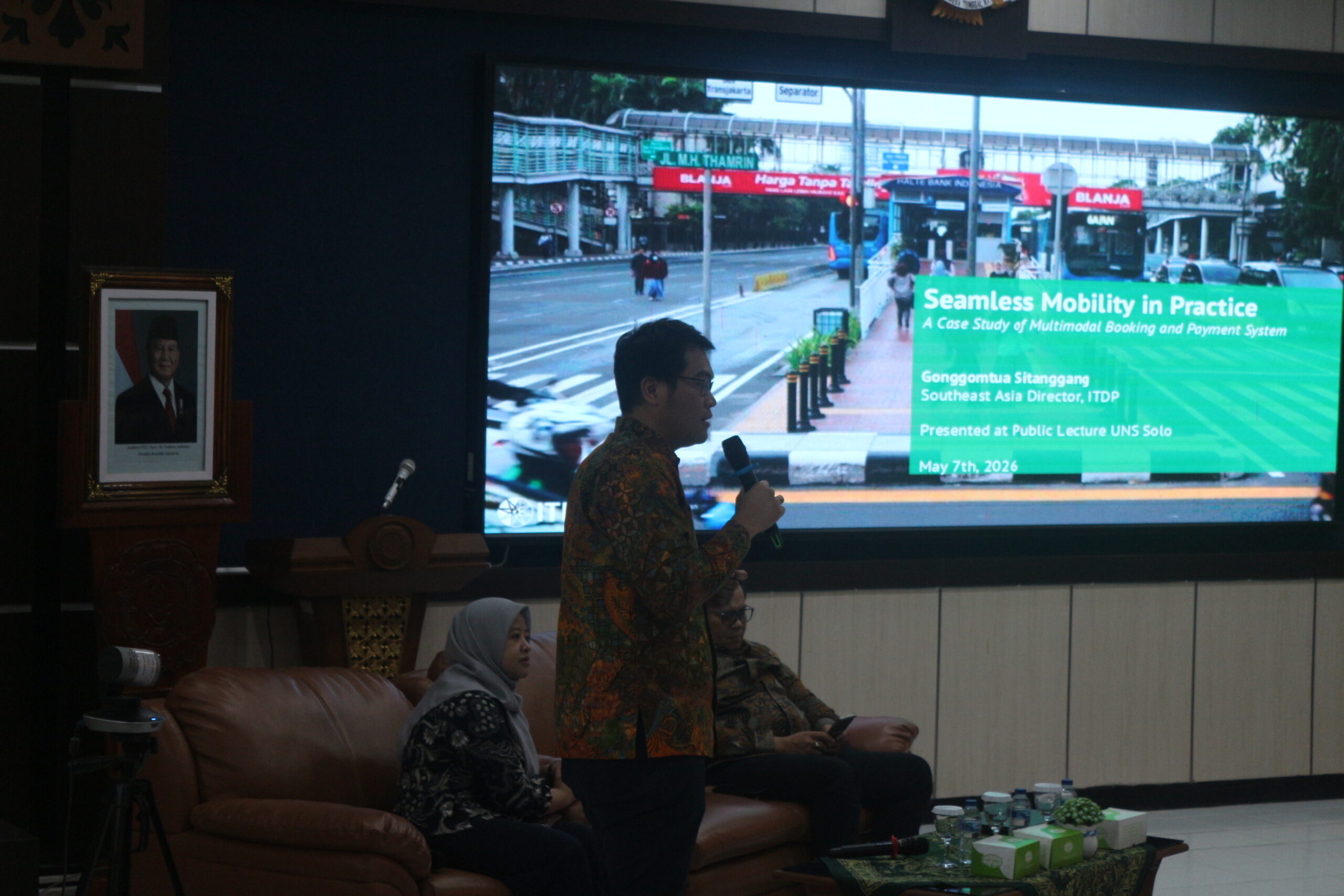
In his presentation, Gonggomtua explained the concept of Mobility as a Service (MaaS), which prioritizes customer experience by integrating multiple modes of transportation into a single system. The key components of MaaS include:
- Integrated transportation modes;
- Integrated payment systems;
- Journey planning; and
- Real-time information and support.
MaaS offers several advantages, including increasing ridership, improving service satisfaction, supporting economic growth, reducing congestion through reliable transportation alternatives, and lowering dependency on private vehicles.
Integrated transportation systems are key to the success of MaaS. Integration should not only focus on institutional and operational coordination, but also include physical infrastructure integration, unified fares and payment systems, and comprehensive information systems. Fare integration in Jakarta has already been demonstrated through the maximum fare cap for MRT, Transjakarta, and Jaklingko services, with a maximum fare of IDR 5,000 for Transjakarta and Jaklingko, and IDR 10,000 for combined MRT, Transjakarta, and Jaklingko journeys within a three-hour travel duration.
However, Jakarta’s urban transportation system—including angkot, BRT, LRT, MRT, and others—still needs to improve and implement a universal digital payment system. The positive impacts of such implementation include improved user convenience, better passenger travel data and information to enhance public transportation services, and more targeted subsidy distribution.