October 12, 2026
ITDP Indonesia Shares Lessons Learned on Inclusive Mobility and Electric Bus Financing at Bangkok Climate Week
Bangkok, 7 October 2026 — Accelerating the transition to sustainable transport requires more than vehicle electrification. Integrating public transport, establishing appropriate financing mechanisms, and providing affordable and inclusive services are essential to ensuring that this transition benefits communities at large.
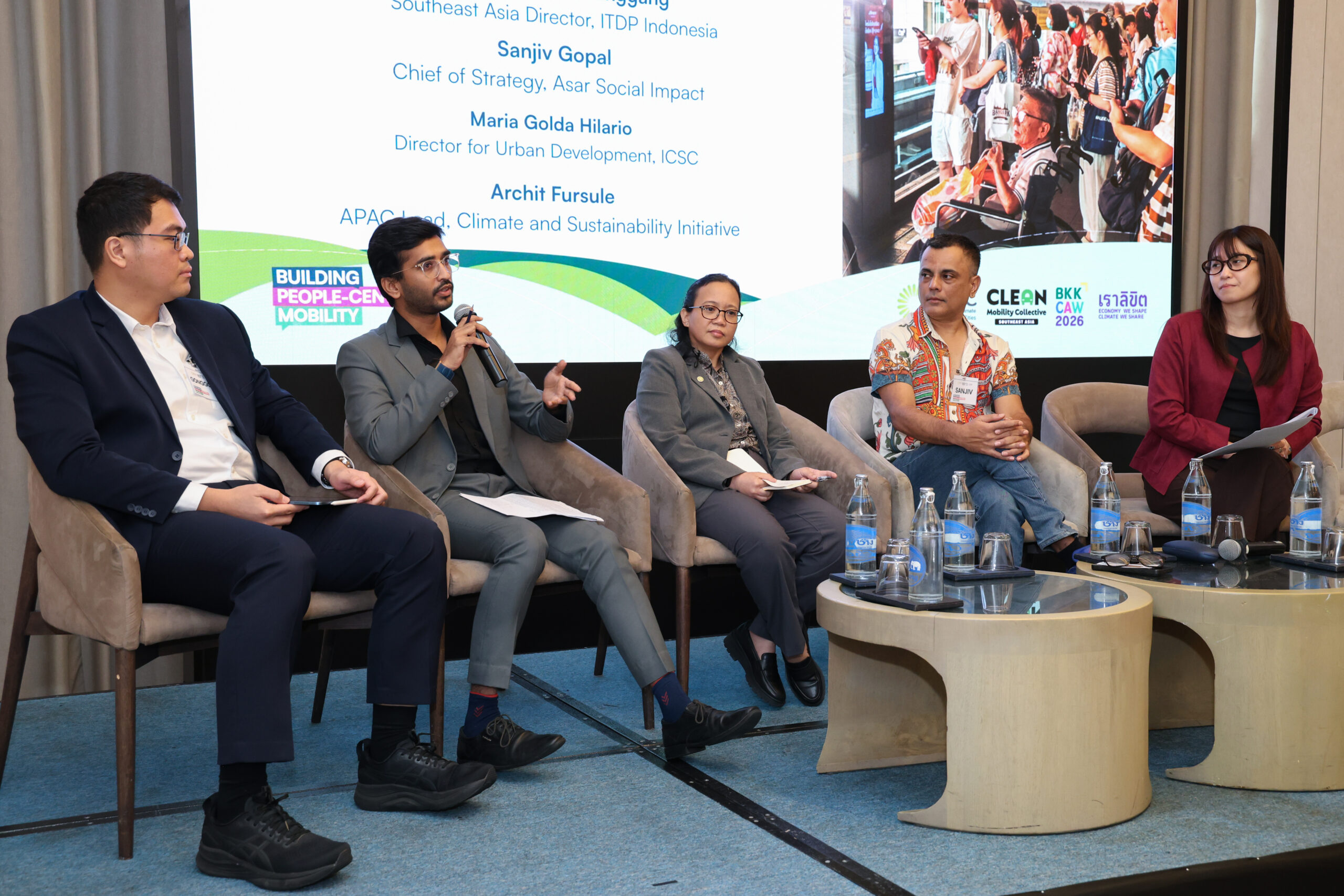
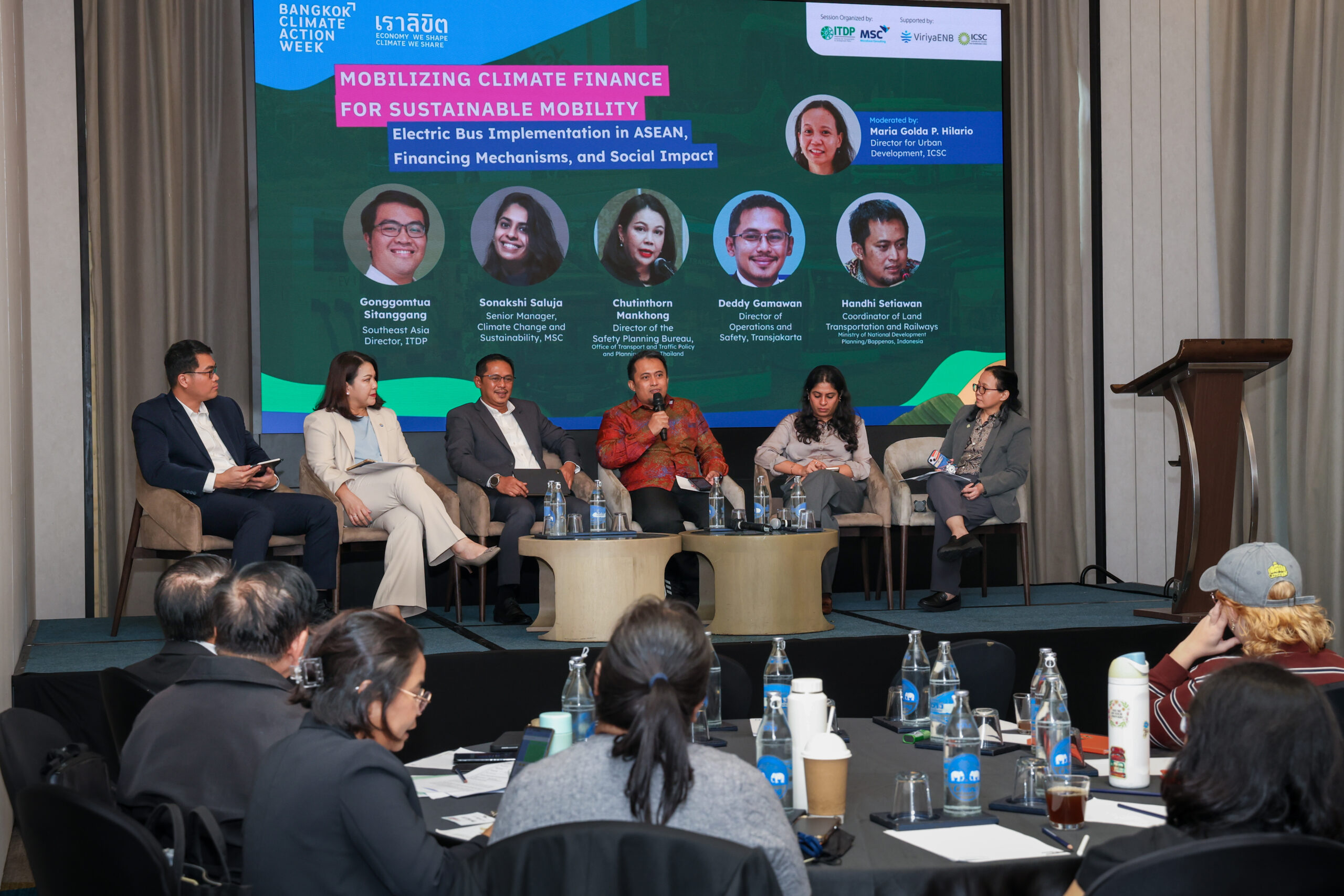
These issues were discussed during two sessions, Building People-Centered Mobility: Where Does the Shift Need to Happen in South and Southeast Asia?and Mobilizing Climate Finance for Sustainable Mobility: Electric Bus Implementation in ASEAN, Financing Mechanisms, and Social Impact, held as part of Bangkok Climate Action Week 2026 in Bangkok, Thailand.
Integrating Public Transport to Meet People’s Mobility Needs
In the first session, ITDP Southeast Asia Director Gonggomtua Sianggang shared Jakarta’s experience in developing public transport, from a system that initially relied heavily on informal transport services to the development of bus rapid transit (BRT). Although integration has progressed through initiatives such as JakLingko, first- and last-mile connectivity remains a challenge. Gonggomtua therefore emphasized the importance of institutional, fare, and physical integration, including to accommodate cross-regional journeys across Greater Jakarta. ITDP Indonesia continues to work with governments to strengthen integration based on people’s actual mobility patterns.
Experiences from India and the Philippines also highlighted the importance of policy support in public transport development. Archit Fursule from Climate and Sustainability Initiatives (CSI) explained that India is moving from a system heavily reliant on informal transport services towards more formalized operations through Gross Cost Contract (GCC) models. The expansion of public transport services in India is also gaining momentum, supported by stronger commitments from central and state governments.
Meanwhile, Maria Golda P. Hilario from the Institute for Climate and Sustainable Cities (ICSC) shared the Philippines’ experience in electrifying jeepneys. As one of the pioneers supporting jeepney electrification, ICSC sees the transition as an opportunity to improve public transport service quality. However, regulatory frameworks and public financing mechanisms need to be strengthened, particularly because operators face difficulties securing bank loans for electric vehicles. Transjakarta’s experience also highlights the importance of identifying suitable business models to support electrification.
Financing the Transition to Electric Buses
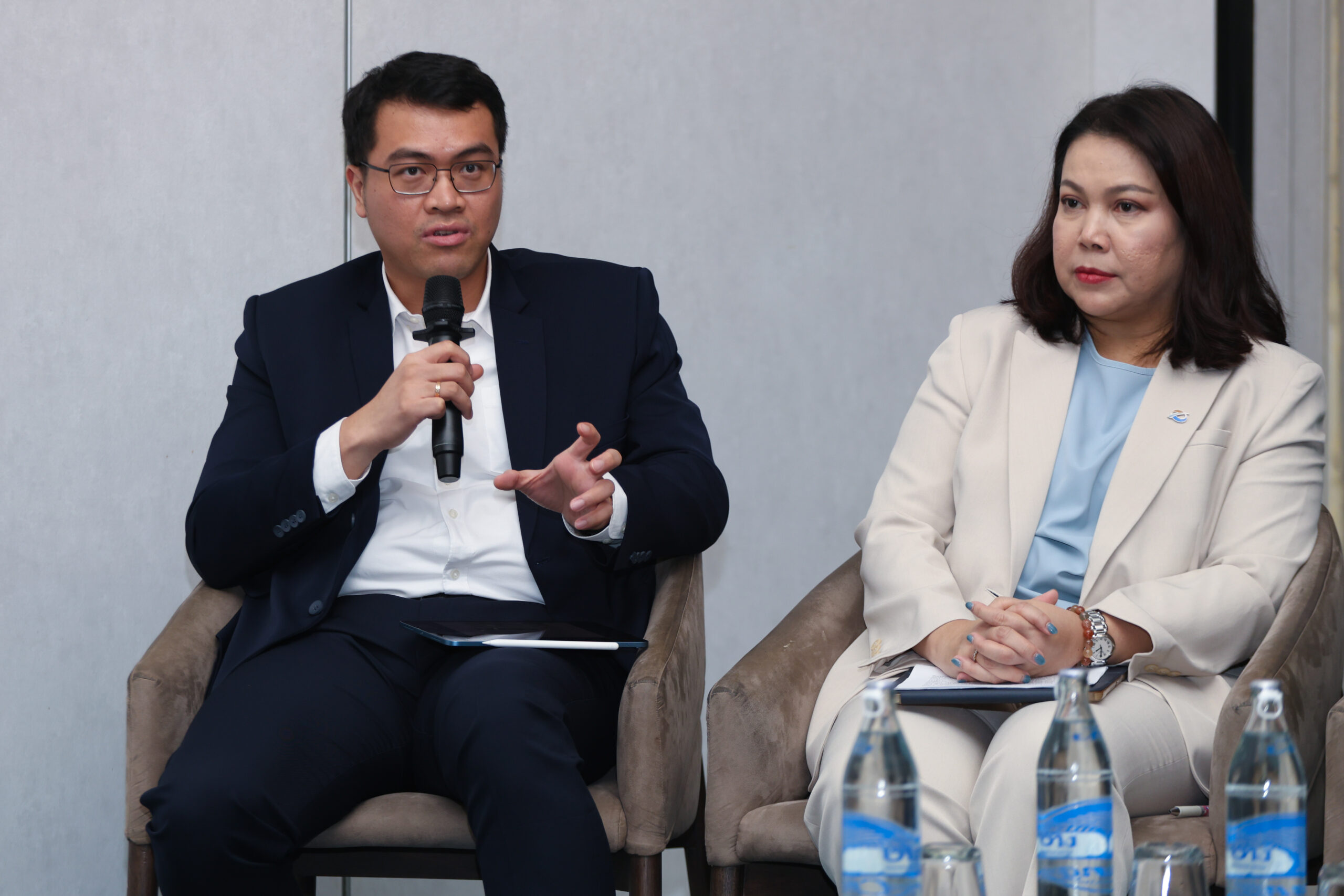
In the second session, Chutinhorn Mangkhong, Director of the Transport and Safety Bureau at Thailand’s Office of Transport and Traffic Policy and Planning (OTP), presented the 30@30 policy, which aims for electric vehicles to account for 30% of total vehicle production by 2030. Thailand is also encouraging private-sector participation and exploring the use of carbon emission reductions as a financing mechanism for electric buses. The government is further encouraging a shift from private vehicles to public transport.
Representing Indonesia, Mohamad Deddy Gamawan, Director of Operations and Safety at Transjakarta, explained that the Jakarta Provincial Government has set a target to electrify Transjakarta’s entire fleet by 2030, requiring approximately 10,000 buses. The current gross cost contract rate per kilometer for large electric buses is around 5% lower than that of conventional buses. However, the upfront investment remains two to three times higher.
To finance the transition, Gonggomtua highlighted alternative financing options, including a combination of concessional financing and fleet leasing. An ITDP study conducted in 2023 found that combining these mechanisms could improve the efficiency of Transjakarta’s budget allocation. Another challenge is securing land for charging facilities for minibuses operated by cooperatives and individual operators.
Ensuring an Inclusive and Sustainable Transition
Electrification also presents opportunities to improve accessibility and expand employment opportunities. Gonggomtua emphasized that electric buses can be equipped with accessibility features such as Braille signage and designated wheelchair spaces. ITDP Indonesia also supports Transjakarta Academy, which includes a training program for female bus drivers.
Sonakshi Saluja, Senior Manager of Climate Change and Sustainability at MSC, also emphasized the importance of bottom-up planning to ensure that the needs and perspectives of vulnerable groups are considered in transport development. According to Sonakshi, the transition to sustainable mobility should help create more inclusive cities by involving communities in the planning process. She also highlighted that applying carbon credit mechanisms to active mobility requires strong accountability and transparent methodologies to ensure that emission reductions can be accurately measured.
However, electrification alone is not enough to reduce transport emissions. Gonggomtua emphasized the Avoid–Shift–Improve framework: reducing the need for travel, encouraging a shift to sustainable modes, and improving vehicle technology. ITDP Indonesia also advocates for public transport to be recognized as a mandatory basic service, enabling governments to allocate dedicated budgets for its provision and development.
By combining integration, appropriate financing, electrification, and accessibility, the transport transition can support a more affordable and inclusive mobility system.